Best Features of RFP Software in 2026
Jan 27, 2026

Table of Content |
|---|
Why Traditional RFP Methods No Longer Work |
Core Feature 1: AI Powered Requirement Extraction |
Core Feature 2: Intelligent Content Library with AI Proposal Generator |
Core Feature 3: AI-Powered Risk Identification |
Core Feature 4: Seamless Collaboration and Workflow Management |
Core Feature 5: Compliance Matrix Automation |
Core Feature 6: AI-Powered Proposal Generation |
Core Feature 7: Document Comparison and Version Control |
Core Feature 8: Integration Capabilities |
Core Feature 9: Analytics and Performance Tracking |
Core Feature 10: Security and Compliance |
Evaluating ROI: What to Expect from Modern RFP Software |
Implementation Considerations |
Why DocuSensa Delivers on These Critical Features |
Making Your Decision: A Final Checklist |
Transform Your RFP Process with DocuSensa |
Top Features to Look for in RFP Response Software in 2026
The RFP response landscape has fundamentally changed. Teams managing proposal workflows manually face mounting pressure: tighter deadlines, higher volumes, and increased expectations for personalization. According to industry data, organizations now handle 40% more RFPs annually than they did three years ago, yet the average response team size has remained flat.
This gap between demand and resources makes selecting the right RFP response software critical for competitive success. The right platform doesn't just speed up your process—it transforms how your team approaches every request for proposal, enabling you to pursue more opportunities while maintaining quality.
This guide breaks down the essential features your RFP software must have in 202, helping you make an informed decision that directly impacts your win rates.

Why Traditional RFP Methods No Longer Work
Before exploring solutions, it's important to understand why manual RFP processes have become unsustainable.
The traditional approach typically involves:
Manually reading through 100+ page documents to extract requirements
Copy-pasting answers from past proposals into spreadsheets
Emailing subject matter experts with vague requests for input
Building compliance matrices by hand
Scrambling to meet submission deadlines with limited review time
This workflow creates three major problems. First, it's extraordinarily time-consuming—proposal managers report spending 60-70% of their time on administrative tasks rather than strategy. Second, it's error-prone, with missed requirements leading to disqualifications. Third, it doesn't scale; adding more RFPs means adding more stress, not more wins.
Modern RFP response software solves these problems through intelligent automation and AI-powered capabilities that handle the tedious work, freeing your team to focus on differentiation and strategy.
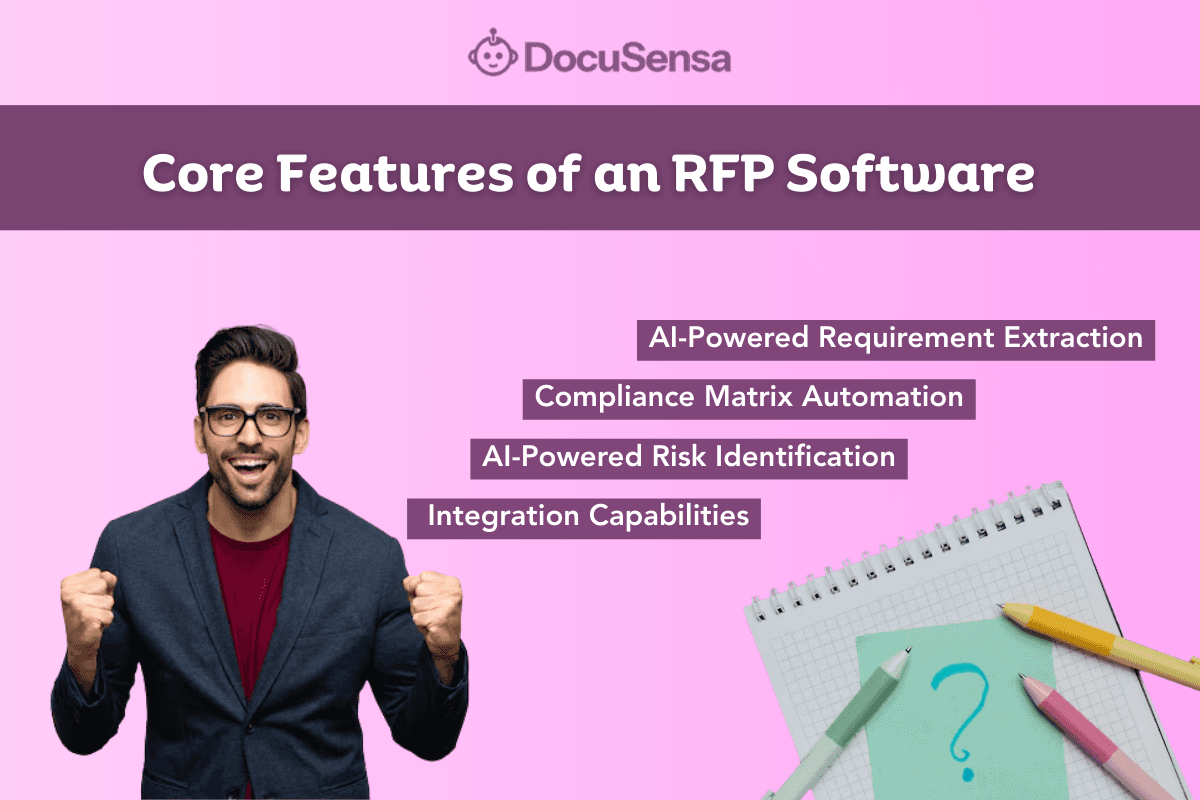
Core Feature 1: AI-Powered Requirement Extraction
The first bottleneck in any RFP response is understanding what the client actually wants. Requirements are often scattered across hundreds of pages, buried in dense legal language, and mixed with background information.
An AI proposal writer equipped with intelligent extraction capabilities transforms this challenge. The software should automatically scan uploaded RFPs and pull out critical information including:
Submission deadlines and format requirements
Mandatory vs. optional requirements
Technical specifications and performance benchmarks
Evaluation criteria and scoring weights
Compliance standards (security certifications, insurance thresholds, legal clauses)
The best systems organize this extracted data into structured, actionable formats—compliance matrices, requirement lists, and deadline trackers—within minutes of upload. This gives your team an immediate head start on every proposal.
Look for platforms that can handle diverse document formats (PDF, Word, Excel) and adapt to different RFP structures without requiring manual configuration. The AI should be sophisticated enough to understand context, not just keyword matching.
Core Feature 2: Intelligent Content Library with AI Proposal Generator
Your organization has likely responded to hundreds of similar questions across past proposals. The challenge is accessing that institutional knowledge efficiently when you need it.
An AI proposal generator integrated with a smart content library solves this problem. The platform should maintain a searchable repository of your best proposal content—past answers, case studies, technical specifications, company information, and more.
The critical capability here is intelligent matching. When you upload a new RFP, the AI for RFP responses should automatically suggest relevant content from your library based on semantic understanding, not just keyword matching. If the RFP asks, "Describe your cybersecurity framework," the system should surface your SOC 2 compliance documentation, relevant case studies, and past answers to similar security questions.
Advanced platforms allow you to:
Tag content by topic, product, industry, or compliance requirement
Track content performance (which answers correlate with wins)
Version control to ensure teams use current, approved messaging
Customize suggestions based on client industry or deal size
This feature reduces response time dramatically while ensuring consistency and quality across all proposals.
Core Feature 3: AI-Powered Risk Identification
Not every RFP is worth pursuing. Some contain unfavorable terms that could expose your organization to financial or legal risk. Others have requirements you can't meet, making your bid uncompetitive from the start.
Leading bid and proposal software includes automated risk flagging that scans RFPs for potential deal-breakers:
Unfavorable payment terms (net-90 instead of net-30)
High liability or indemnity clauses
Unrealistic timelines or deliverables
Technical requirements outside your capabilities
Non-standard intellectual property ownership terms
The software should highlight these risks immediately, allowing you to make informed bid/no-bid decisions before investing significant resources. For risks you choose to accept, the platform should flag them for legal review and negotiation during the contracting phase.
Configurable rule sets are essential—your organization's risk tolerance differs from competitors, so the platform should let you define what constitutes a red flag based on your business model and policies.
Core Feature 4: Seamless Collaboration and Workflow Management
RFP responses require input from multiple stakeholders: sales, product, legal, finance, and technical teams. Coordinating these contributors is often more challenging than the actual writing.
Your software should include robust collaboration features:
Assignment Management: Automatically route sections to appropriate subject matter experts based on question type
Real-Time Collaboration: Multiple users can work simultaneously without version conflicts
Targeted Notifications: Alert contributors only about their assigned sections, not the entire RFP
Approval Workflows: Define review stages (initial draft, technical review, legal approval, executive sign-off) with automatic routing
Commenting and Feedback: In-line comments and suggestions, similar to Google Docs
The platform should integrate with your existing communication tools—Slack, Microsoft Teams, or email—so contributors don't need to constantly check another system. Notifications should be intelligent, escalating only when deadlines approach or approvals are stuck.
Core Feature 5: Compliance Matrix Automation
Most RFPs include detailed compliance requirements that must be explicitly addressed in your response. Creating a compliance matrix—a table mapping each requirement to your response—is typically a manual, time-consuming process prone to errors.
Advanced RFP software automates this completely. The AI should:
Extract all mandatory and optional requirements from the RFP
Create a structured compliance matrix automatically
Map your draft responses to specific requirements
Flag any requirements not yet addressed
Verify that your response format matches the client's requested structure
This automation is particularly valuable for government RFPs and highly regulated industries where missing a single requirement means automatic disqualification. The compliance matrix becomes a living document, updating as your team drafts responses and providing real-time visibility into completion status.
Core Feature 6: AI-Powered Proposal Generation
While content libraries provide building blocks, the best platforms go further with AI proposal generators that can draft complete sections based on the RFP requirements and your knowledge base.
This doesn't mean the AI writes your entire proposal—that would lack the customization needed to win. Instead, the AI creates intelligent first drafts that your team can refine and personalize. The system should:
Generate executive summaries that connect the client's stated problem to your solution
Draft methodology sections based on your past approaches and the client's specific requirements
Suggest team bios and relevant experience based on project scope
Create customized case studies by pulling relevant examples from your library
The goal is to reduce first-draft time from days to hours, letting your proposal managers and subject matter experts focus on customization, differentiation, and strategic messaging rather than starting from a blank page.
Core Feature 7: Document Comparison and Version Control
As your proposal evolves through multiple review cycles, maintaining version control becomes critical. The software should track all changes with detailed revision history, allowing you to see who changed what and when.
Document comparison features are equally important, especially when:
Multiple team members are working on different sections
You're responding to amended RFPs with updated requirements
You need to compare your draft against the winning proposal (if shared post-award)
The platform should highlight differences between versions visually, making it easy to review changes during approval cycles and ensuring that legal or compliance edits aren't accidentally overwritten in later revisions.
Core Feature 8: Integration Capabilities
Your RFP software shouldn't exist in isolation. It needs to connect with your broader business ecosystem to maximize efficiency and data flow.
Essential integrations include:
CRM Systems (Salesforce, HubSpot, Close): Automatically create proposal projects when opportunities reach certain stages; update deal status based on proposal submission
Document Storage (Google Drive, SharePoint, Dropbox): Access your existing content library without duplicating files
E-signature Platforms (DocuSign, Adobe Sign): Route approved proposals for executive signatures
Project Management Tools (Asana, Monday.com): Sync proposal deadlines and milestones
Communication Platforms (Slack, Teams): Send notifications and updates
API access is critical for custom integrations specific to your workflow. The platform should offer both pre-built connectors for common tools and flexible APIs for custom development.
Core Feature 9: Analytics and Performance Tracking
You can't improve what you don't measure. Your RFP software should provide detailed analytics on both process efficiency and proposal effectiveness.
Key metrics to track include:
Response Time: How long does it take from RFP receipt to submission?
Win Rate: What percentage of submitted proposals result in contracts?
Content Performance: Which answers and case studies appear in winning proposals?
Team Productivity: How much time are team members spending on each RFP?
Bottleneck Identification: Where do proposals get stuck in the workflow?
Advanced platforms provide win/loss analysis, helping you identify patterns in successful proposals. Was it your pricing strategy? Your technical approach? The specific case studies you used? This insight is invaluable for continuously improving your proposal strategy.
Core Feature 10: Security and Compliance
RFPs often contain sensitive information about your organization and your clients. Your software must provide enterprise-grade security, including:
End-to-end encryption for all documents and communications
Role-based access controls to restrict who can view, edit, or approve proposals
Audit trails showing all system activity for compliance purposes
Data residency options for organizations with geographic requirements
SOC 2 Type II certification or similar third-party security validation
For organizations in regulated industries (healthcare, finance, government contractors), ensure the platform meets specific compliance standards like HIPAA, ITAR, or FedRAMP.
Evaluating ROI: What to Expect from Modern RFP Software
Understanding the expected return on investment helps justify the software purchase to stakeholders and sets realistic performance benchmarks.
Organizations typically see:
70-80% reduction in time spent on administrative tasks (requirement extraction, compliance matrix creation)
40-60% faster proposal response times
15-25% increase in proposal volume capacity without adding headcount
10-20% improvement in win rates due to better quality, consistency, and on-time submissions
Calculate your potential ROI by estimating:
Current time spent per proposal (in person-hours)
Average fully-loaded cost per hour for your proposal team
Number of proposals submitted annually
Percentage of time spent on tasks the software would automate
Most organizations with active RFP workflows see positive ROI within 6-12 months.
Implementation Considerations
Even the best software fails if implementation is rushed or poorly planned. Consider these factors when rolling out new RFP software:
Change Management: Your team has established workflows, even if inefficient. Plan for training, create champions within each department, and phase the rollout to avoid overwhelming users.
Content Migration: Transferring your existing proposal library into the new system takes time. Prioritize your most frequently used content and plan for ongoing library curation.
Integration Timeline: Connecting the RFP platform to your CRM, document storage, and other tools requires IT involvement. Budget time for API development and testing.
Vendor Support: Evaluate the vendor's implementation support, training resources, and ongoing customer success programs. The best software is useless without proper enablement.
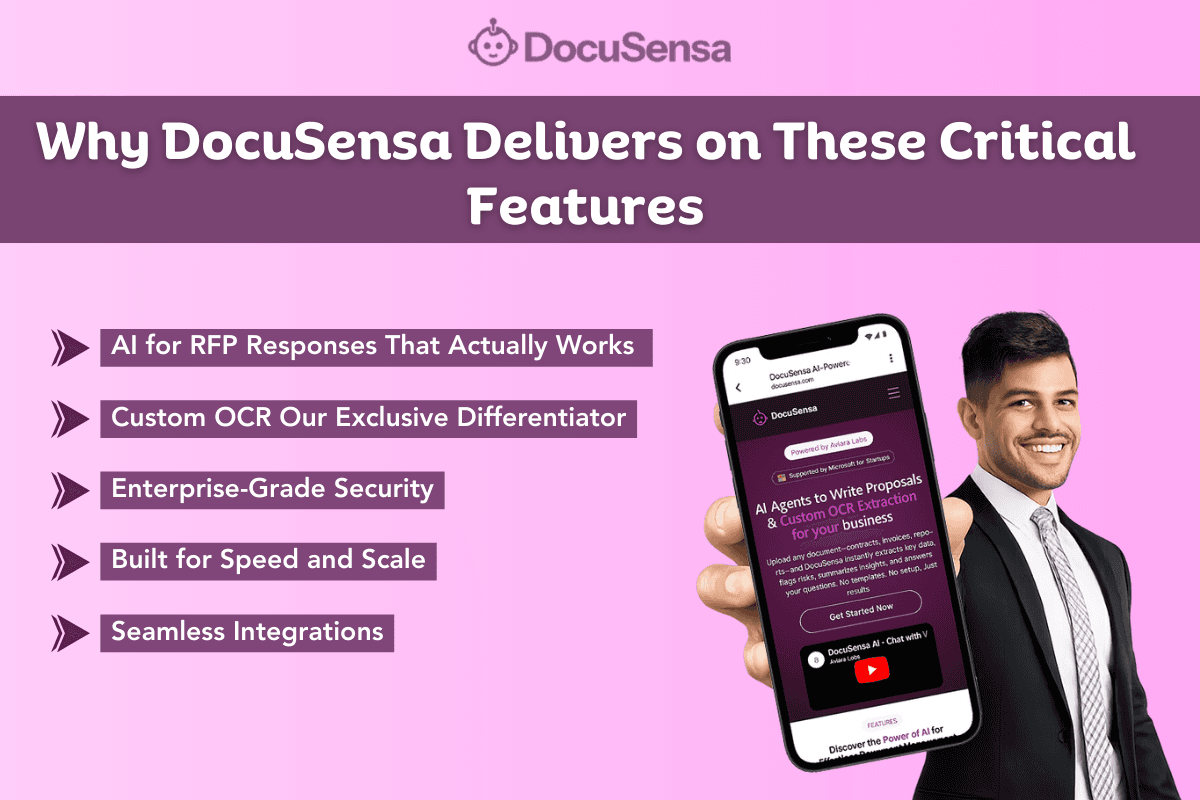
Why DocuSensa Delivers on These Critical Features
DocuSensa is purpose-built to address the specific challenges of modern RFP response teams. The platform brings together all the features outlined in this guide within a single, integrated solution designed specifically for bid and proposal workflows.
AI for RFP Responses That Actually Works DocuSensa's AI engine leverages advanced natural language processing to understand RFP requirements in context, not just match keywords. This means more accurate requirement extraction, better content suggestions, and intelligent first drafts that actually align with client needs.
Custom OCR Fields: Our Exclusive Differentiator Unlike generic document AI tools, DocuSensa lets you define custom data extraction fields specific to your business. Whether you need to capture specific compliance certifications, extract custom pricing structures, or pull out industry-specific requirements, you can configure the platform to automatically extract exactly what matters to your organization.
Built for Speed and Scale DocuSensa was designed for teams managing high proposal volumes. The platform dramatically reduces response timelines through automation while maintaining the quality and customization needed to win. Organizations using DocuSensa report handling 2-3x more proposals with the same team size.
Enterprise-Grade Security With SOC 2 Type II certification and comprehensive security controls, DocuSensa protects your sensitive proposal content and client information. Role-based access controls ensure that team members see only what they need, while detailed audit trails provide visibility for compliance and governance.
Seamless Integrations DocuSensa connects with your existing business tools—from CRMs like HubSpot and Salesforce to document storage solutions and project management platforms. This eliminates duplicate data entry and creates a unified workflow from opportunity identification through contract signing.
Making Your Decision: A Final Checklist
When evaluating RFP response software, use this checklist to ensure you're choosing a platform that will genuinely transform your process:
AI-powered requirement extraction that handles diverse document formats
Intelligent content library with semantic search and automated suggestions
Risk flagging and compliance checking based on your business rules
Real-time collaboration with workflow automation
Automated compliance matrix generation
AI proposal generator for intelligent first drafts
Document comparison and version control
Integration with your existing business tools
Analytics and win/loss tracking
Enterprise security and compliance certifications
Vendor with proven implementation support and customer success
The difference between winning and losing competitive bids increasingly comes down to operational efficiency and proposal quality—areas where the right software creates measurable competitive advantage.

Transform Your RFP Process with DocuSensa
The RFP response process doesn't have to be painful. With the right software, your team can respond to more opportunities, submit higher-quality proposals, and win more business—all without expanding headcount or sacrificing work-life balance.
DocuSensa brings together all the features outlined in this guide in a platform specifically designed for modern proposal teams. Our AI proposal generator automates the tedious work, our intelligent content library ensures consistency and quality, and our analytics give you the insights needed to continuously improve your win rate.
Don't let outdated processes limit your growth. See how DocuSensa can transform your RFP workflow.
Start your free trial of DocuSensa today and experience the power of AI-driven proposal management.
Table of Content |
|---|
Why Traditional RFP Methods No Longer Work |
Core Feature 1: AI Powered Requirement Extraction |
Core Feature 2: Intelligent Content Library with AI Proposal Generator |
Core Feature 3: AI-Powered Risk Identification |
Core Feature 4: Seamless Collaboration and Workflow Management |
Core Feature 5: Compliance Matrix Automation |
Core Feature 6: AI-Powered Proposal Generation |
Core Feature 7: Document Comparison and Version Control |
Core Feature 8: Integration Capabilities |
Core Feature 9: Analytics and Performance Tracking |
Core Feature 10: Security and Compliance |
Evaluating ROI: What to Expect from Modern RFP Software |
Implementation Considerations |
Why DocuSensa Delivers on These Critical Features |
Making Your Decision: A Final Checklist |
Transform Your RFP Process with DocuSensa |
Top Features to Look for in RFP Response Software in 2026
The RFP response landscape has fundamentally changed. Teams managing proposal workflows manually face mounting pressure: tighter deadlines, higher volumes, and increased expectations for personalization. According to industry data, organizations now handle 40% more RFPs annually than they did three years ago, yet the average response team size has remained flat.
This gap between demand and resources makes selecting the right RFP response software critical for competitive success. The right platform doesn't just speed up your process—it transforms how your team approaches every request for proposal, enabling you to pursue more opportunities while maintaining quality.
This guide breaks down the essential features your RFP software must have in 202, helping you make an informed decision that directly impacts your win rates.
Why Traditional RFP Methods No Longer Work
Before exploring solutions, it's important to understand why manual RFP processes have become unsustainable.
The traditional approach typically involves:
Manually reading through 100+ page documents to extract requirements
Copy-pasting answers from past proposals into spreadsheets
Emailing subject matter experts with vague requests for input
Building compliance matrices by hand
Scrambling to meet submission deadlines with limited review time
This workflow creates three major problems. First, it's extraordinarily time-consuming—proposal managers report spending 60-70% of their time on administrative tasks rather than strategy. Second, it's error-prone, with missed requirements leading to disqualifications. Third, it doesn't scale; adding more RFPs means adding more stress, not more wins.
Modern RFP response software solves these problems through intelligent automation and AI-powered capabilities that handle the tedious work, freeing your team to focus on differentiation and strategy.
Core Feature 1: AI-Powered Requirement Extraction
The first bottleneck in any RFP response is understanding what the client actually wants. Requirements are often scattered across hundreds of pages, buried in dense legal language, and mixed with background information.
An AI proposal writer equipped with intelligent extraction capabilities transforms this challenge. The software should automatically scan uploaded RFPs and pull out critical information including:
Submission deadlines and format requirements
Mandatory vs. optional requirements
Technical specifications and performance benchmarks
Evaluation criteria and scoring weights
Compliance standards (security certifications, insurance thresholds, legal clauses)
The best systems organize this extracted data into structured, actionable formats—compliance matrices, requirement lists, and deadline trackers—within minutes of upload. This gives your team an immediate head start on every proposal.
Look for platforms that can handle diverse document formats (PDF, Word, Excel) and adapt to different RFP structures without requiring manual configuration. The AI should be sophisticated enough to understand context, not just keyword matching.
Core Feature 2: Intelligent Content Library with AI Proposal Generator
Your organization has likely responded to hundreds of similar questions across past proposals. The challenge is accessing that institutional knowledge efficiently when you need it.
An AI proposal generator integrated with a smart content library solves this problem. The platform should maintain a searchable repository of your best proposal content—past answers, case studies, technical specifications, company information, and more.
The critical capability here is intelligent matching. When you upload a new RFP, the AI for RFP responses should automatically suggest relevant content from your library based on semantic understanding, not just keyword matching. If the RFP asks, "Describe your cybersecurity framework," the system should surface your SOC 2 compliance documentation, relevant case studies, and past answers to similar security questions.
Advanced platforms allow you to:
Tag content by topic, product, industry, or compliance requirement
Track content performance (which answers correlate with wins)
Version control to ensure teams use current, approved messaging
Customize suggestions based on client industry or deal size
This feature reduces response time dramatically while ensuring consistency and quality across all proposals.
Core Feature 3: AI-Powered Risk Identification
Not every RFP is worth pursuing. Some contain unfavorable terms that could expose your organization to financial or legal risk. Others have requirements you can't meet, making your bid uncompetitive from the start.
Leading bid and proposal software includes automated risk flagging that scans RFPs for potential deal-breakers:
Unfavorable payment terms (net-90 instead of net-30)
High liability or indemnity clauses
Unrealistic timelines or deliverables
Technical requirements outside your capabilities
Non-standard intellectual property ownership terms
The software should highlight these risks immediately, allowing you to make informed bid/no-bid decisions before investing significant resources. For risks you choose to accept, the platform should flag them for legal review and negotiation during the contracting phase.
Configurable rule sets are essential—your organization's risk tolerance differs from competitors, so the platform should let you define what constitutes a red flag based on your business model and policies.
Core Feature 4: Seamless Collaboration and Workflow Management
RFP responses require input from multiple stakeholders: sales, product, legal, finance, and technical teams. Coordinating these contributors is often more challenging than the actual writing.
Your software should include robust collaboration features:
Assignment Management: Automatically route sections to appropriate subject matter experts based on question type
Real-Time Collaboration: Multiple users can work simultaneously without version conflicts
Targeted Notifications: Alert contributors only about their assigned sections, not the entire RFP
Approval Workflows: Define review stages (initial draft, technical review, legal approval, executive sign-off) with automatic routing
Commenting and Feedback: In-line comments and suggestions, similar to Google Docs
The platform should integrate with your existing communication tools—Slack, Microsoft Teams, or email—so contributors don't need to constantly check another system. Notifications should be intelligent, escalating only when deadlines approach or approvals are stuck.
Core Feature 5: Compliance Matrix Automation
Most RFPs include detailed compliance requirements that must be explicitly addressed in your response. Creating a compliance matrix—a table mapping each requirement to your response—is typically a manual, time-consuming process prone to errors.
Advanced RFP software automates this completely. The AI should:
Extract all mandatory and optional requirements from the RFP
Create a structured compliance matrix automatically
Map your draft responses to specific requirements
Flag any requirements not yet addressed
Verify that your response format matches the client's requested structure
This automation is particularly valuable for government RFPs and highly regulated industries where missing a single requirement means automatic disqualification. The compliance matrix becomes a living document, updating as your team drafts responses and providing real-time visibility into completion status.
Core Feature 6: AI-Powered Proposal Generation
While content libraries provide building blocks, the best platforms go further with AI proposal generators that can draft complete sections based on the RFP requirements and your knowledge base.
This doesn't mean the AI writes your entire proposal—that would lack the customization needed to win. Instead, the AI creates intelligent first drafts that your team can refine and personalize. The system should:
Generate executive summaries that connect the client's stated problem to your solution
Draft methodology sections based on your past approaches and the client's specific requirements
Suggest team bios and relevant experience based on project scope
Create customized case studies by pulling relevant examples from your library
The goal is to reduce first-draft time from days to hours, letting your proposal managers and subject matter experts focus on customization, differentiation, and strategic messaging rather than starting from a blank page.
Core Feature 7: Document Comparison and Version Control
As your proposal evolves through multiple review cycles, maintaining version control becomes critical. The software should track all changes with detailed revision history, allowing you to see who changed what and when.
Document comparison features are equally important, especially when:
Multiple team members are working on different sections
You're responding to amended RFPs with updated requirements
You need to compare your draft against the winning proposal (if shared post-award)
The platform should highlight differences between versions visually, making it easy to review changes during approval cycles and ensuring that legal or compliance edits aren't accidentally overwritten in later revisions.
Core Feature 8: Integration Capabilities
Your RFP software shouldn't exist in isolation. It needs to connect with your broader business ecosystem to maximize efficiency and data flow.
Essential integrations include:
CRM Systems (Salesforce, HubSpot, Close): Automatically create proposal projects when opportunities reach certain stages; update deal status based on proposal submission
Document Storage (Google Drive, SharePoint, Dropbox): Access your existing content library without duplicating files
E-signature Platforms (DocuSign, Adobe Sign): Route approved proposals for executive signatures
Project Management Tools (Asana, Monday.com): Sync proposal deadlines and milestones
Communication Platforms (Slack, Teams): Send notifications and updates
API access is critical for custom integrations specific to your workflow. The platform should offer both pre-built connectors for common tools and flexible APIs for custom development.
Core Feature 9: Analytics and Performance Tracking
You can't improve what you don't measure. Your RFP software should provide detailed analytics on both process efficiency and proposal effectiveness.
Key metrics to track include:
Response Time: How long does it take from RFP receipt to submission?
Win Rate: What percentage of submitted proposals result in contracts?
Content Performance: Which answers and case studies appear in winning proposals?
Team Productivity: How much time are team members spending on each RFP?
Bottleneck Identification: Where do proposals get stuck in the workflow?
Advanced platforms provide win/loss analysis, helping you identify patterns in successful proposals. Was it your pricing strategy? Your technical approach? The specific case studies you used? This insight is invaluable for continuously improving your proposal strategy.
Core Feature 10: Security and Compliance
RFPs often contain sensitive information about your organization and your clients. Your software must provide enterprise-grade security, including:
End-to-end encryption for all documents and communications
Role-based access controls to restrict who can view, edit, or approve proposals
Audit trails showing all system activity for compliance purposes
Data residency options for organizations with geographic requirements
SOC 2 Type II certification or similar third-party security validation
For organizations in regulated industries (healthcare, finance, government contractors), ensure the platform meets specific compliance standards like HIPAA, ITAR, or FedRAMP.
Evaluating ROI: What to Expect from Modern RFP Software
Understanding the expected return on investment helps justify the software purchase to stakeholders and sets realistic performance benchmarks.
Organizations typically see:
70-80% reduction in time spent on administrative tasks (requirement extraction, compliance matrix creation)
40-60% faster proposal response times
15-25% increase in proposal volume capacity without adding headcount
10-20% improvement in win rates due to better quality, consistency, and on-time submissions
Calculate your potential ROI by estimating:
Current time spent per proposal (in person-hours)
Average fully-loaded cost per hour for your proposal team
Number of proposals submitted annually
Percentage of time spent on tasks the software would automate
Most organizations with active RFP workflows see positive ROI within 6-12 months.
Implementation Considerations
Even the best software fails if implementation is rushed or poorly planned. Consider these factors when rolling out new RFP software:
Change Management: Your team has established workflows, even if inefficient. Plan for training, create champions within each department, and phase the rollout to avoid overwhelming users.
Content Migration: Transferring your existing proposal library into the new system takes time. Prioritize your most frequently used content and plan for ongoing library curation.
Integration Timeline: Connecting the RFP platform to your CRM, document storage, and other tools requires IT involvement. Budget time for API development and testing.
Vendor Support: Evaluate the vendor's implementation support, training resources, and ongoing customer success programs. The best software is useless without proper enablement.
Why DocuSensa Delivers on These Critical Features
DocuSensa is purpose-built to address the specific challenges of modern RFP response teams. The platform brings together all the features outlined in this guide within a single, integrated solution designed specifically for bid and proposal workflows.
AI for RFP Responses That Actually Works DocuSensa's AI engine leverages advanced natural language processing to understand RFP requirements in context, not just match keywords. This means more accurate requirement extraction, better content suggestions, and intelligent first drafts that actually align with client needs.
Custom OCR Fields: Our Exclusive Differentiator Unlike generic document AI tools, DocuSensa lets you define custom data extraction fields specific to your business. Whether you need to capture specific compliance certifications, extract custom pricing structures, or pull out industry-specific requirements, you can configure the platform to automatically extract exactly what matters to your organization.
Built for Speed and Scale DocuSensa was designed for teams managing high proposal volumes. The platform dramatically reduces response timelines through automation while maintaining the quality and customization needed to win. Organizations using DocuSensa report handling 2-3x more proposals with the same team size.
Enterprise-Grade Security With SOC 2 Type II certification and comprehensive security controls, DocuSensa protects your sensitive proposal content and client information. Role-based access controls ensure that team members see only what they need, while detailed audit trails provide visibility for compliance and governance.
Seamless Integrations DocuSensa connects with your existing business tools—from CRMs like HubSpot and Salesforce to document storage solutions and project management platforms. This eliminates duplicate data entry and creates a unified workflow from opportunity identification through contract signing.
Making Your Decision: A Final Checklist
When evaluating RFP response software, use this checklist to ensure you're choosing a platform that will genuinely transform your process:
AI-powered requirement extraction that handles diverse document formats
Intelligent content library with semantic search and automated suggestions
Risk flagging and compliance checking based on your business rules
Real-time collaboration with workflow automation
Automated compliance matrix generation
AI proposal generator for intelligent first drafts
Document comparison and version control
Integration with your existing business tools
Analytics and win/loss tracking
Enterprise security and compliance certifications
Vendor with proven implementation support and customer success
The difference between winning and losing competitive bids increasingly comes down to operational efficiency and proposal quality—areas where the right software creates measurable competitive advantage.
Transform Your RFP Process with DocuSensa
The RFP response process doesn't have to be painful. With the right software, your team can respond to more opportunities, submit higher-quality proposals, and win more business—all without expanding headcount or sacrificing work-life balance.
DocuSensa brings together all the features outlined in this guide in a platform specifically designed for modern proposal teams. Our AI proposal generator automates the tedious work, our intelligent content library ensures consistency and quality, and our analytics give you the insights needed to continuously improve your win rate.
Don't let outdated processes limit your growth. See how DocuSensa can transform your RFP workflow.
Start your free trial of DocuSensa today and experience the power of AI-driven proposal management.
Table of Content |
|---|
Why Traditional RFP Methods No Longer Work |
Core Feature 1: AI Powered Requirement Extraction |
Core Feature 2: Intelligent Content Library with AI Proposal Generator |
Core Feature 3: AI-Powered Risk Identification |
Core Feature 4: Seamless Collaboration and Workflow Management |
Core Feature 5: Compliance Matrix Automation |
Core Feature 6: AI-Powered Proposal Generation |
Core Feature 7: Document Comparison and Version Control |
Core Feature 8: Integration Capabilities |
Core Feature 9: Analytics and Performance Tracking |
Core Feature 10: Security and Compliance |
Evaluating ROI: What to Expect from Modern RFP Software |
Implementation Considerations |
Why DocuSensa Delivers on These Critical Features |
Making Your Decision: A Final Checklist |
Transform Your RFP Process with DocuSensa |
Top Features to Look for in RFP Response Software in 2026
The RFP response landscape has fundamentally changed. Teams managing proposal workflows manually face mounting pressure: tighter deadlines, higher volumes, and increased expectations for personalization. According to industry data, organizations now handle 40% more RFPs annually than they did three years ago, yet the average response team size has remained flat.
This gap between demand and resources makes selecting the right RFP response software critical for competitive success. The right platform doesn't just speed up your process—it transforms how your team approaches every request for proposal, enabling you to pursue more opportunities while maintaining quality.
This guide breaks down the essential features your RFP software must have in 202, helping you make an informed decision that directly impacts your win rates.
Why Traditional RFP Methods No Longer Work
Before exploring solutions, it's important to understand why manual RFP processes have become unsustainable.
The traditional approach typically involves:
Manually reading through 100+ page documents to extract requirements
Copy-pasting answers from past proposals into spreadsheets
Emailing subject matter experts with vague requests for input
Building compliance matrices by hand
Scrambling to meet submission deadlines with limited review time
This workflow creates three major problems. First, it's extraordinarily time-consuming—proposal managers report spending 60-70% of their time on administrative tasks rather than strategy. Second, it's error-prone, with missed requirements leading to disqualifications. Third, it doesn't scale; adding more RFPs means adding more stress, not more wins.
Modern RFP response software solves these problems through intelligent automation and AI-powered capabilities that handle the tedious work, freeing your team to focus on differentiation and strategy.
Core Feature 1: AI-Powered Requirement Extraction
The first bottleneck in any RFP response is understanding what the client actually wants. Requirements are often scattered across hundreds of pages, buried in dense legal language, and mixed with background information.
An AI proposal writer equipped with intelligent extraction capabilities transforms this challenge. The software should automatically scan uploaded RFPs and pull out critical information including:
Submission deadlines and format requirements
Mandatory vs. optional requirements
Technical specifications and performance benchmarks
Evaluation criteria and scoring weights
Compliance standards (security certifications, insurance thresholds, legal clauses)
The best systems organize this extracted data into structured, actionable formats—compliance matrices, requirement lists, and deadline trackers—within minutes of upload. This gives your team an immediate head start on every proposal.
Look for platforms that can handle diverse document formats (PDF, Word, Excel) and adapt to different RFP structures without requiring manual configuration. The AI should be sophisticated enough to understand context, not just keyword matching.
Core Feature 2: Intelligent Content Library with AI Proposal Generator
Your organization has likely responded to hundreds of similar questions across past proposals. The challenge is accessing that institutional knowledge efficiently when you need it.
An AI proposal generator integrated with a smart content library solves this problem. The platform should maintain a searchable repository of your best proposal content—past answers, case studies, technical specifications, company information, and more.
The critical capability here is intelligent matching. When you upload a new RFP, the AI for RFP responses should automatically suggest relevant content from your library based on semantic understanding, not just keyword matching. If the RFP asks, "Describe your cybersecurity framework," the system should surface your SOC 2 compliance documentation, relevant case studies, and past answers to similar security questions.
Advanced platforms allow you to:
Tag content by topic, product, industry, or compliance requirement
Track content performance (which answers correlate with wins)
Version control to ensure teams use current, approved messaging
Customize suggestions based on client industry or deal size
This feature reduces response time dramatically while ensuring consistency and quality across all proposals.
Core Feature 3: AI-Powered Risk Identification
Not every RFP is worth pursuing. Some contain unfavorable terms that could expose your organization to financial or legal risk. Others have requirements you can't meet, making your bid uncompetitive from the start.
Leading bid and proposal software includes automated risk flagging that scans RFPs for potential deal-breakers:
Unfavorable payment terms (net-90 instead of net-30)
High liability or indemnity clauses
Unrealistic timelines or deliverables
Technical requirements outside your capabilities
Non-standard intellectual property ownership terms
The software should highlight these risks immediately, allowing you to make informed bid/no-bid decisions before investing significant resources. For risks you choose to accept, the platform should flag them for legal review and negotiation during the contracting phase.
Configurable rule sets are essential—your organization's risk tolerance differs from competitors, so the platform should let you define what constitutes a red flag based on your business model and policies.
Core Feature 4: Seamless Collaboration and Workflow Management
RFP responses require input from multiple stakeholders: sales, product, legal, finance, and technical teams. Coordinating these contributors is often more challenging than the actual writing.
Your software should include robust collaboration features:
Assignment Management: Automatically route sections to appropriate subject matter experts based on question type
Real-Time Collaboration: Multiple users can work simultaneously without version conflicts
Targeted Notifications: Alert contributors only about their assigned sections, not the entire RFP
Approval Workflows: Define review stages (initial draft, technical review, legal approval, executive sign-off) with automatic routing
Commenting and Feedback: In-line comments and suggestions, similar to Google Docs
The platform should integrate with your existing communication tools—Slack, Microsoft Teams, or email—so contributors don't need to constantly check another system. Notifications should be intelligent, escalating only when deadlines approach or approvals are stuck.
Core Feature 5: Compliance Matrix Automation
Most RFPs include detailed compliance requirements that must be explicitly addressed in your response. Creating a compliance matrix—a table mapping each requirement to your response—is typically a manual, time-consuming process prone to errors.
Advanced RFP software automates this completely. The AI should:
Extract all mandatory and optional requirements from the RFP
Create a structured compliance matrix automatically
Map your draft responses to specific requirements
Flag any requirements not yet addressed
Verify that your response format matches the client's requested structure
This automation is particularly valuable for government RFPs and highly regulated industries where missing a single requirement means automatic disqualification. The compliance matrix becomes a living document, updating as your team drafts responses and providing real-time visibility into completion status.
Core Feature 6: AI-Powered Proposal Generation
While content libraries provide building blocks, the best platforms go further with AI proposal generators that can draft complete sections based on the RFP requirements and your knowledge base.
This doesn't mean the AI writes your entire proposal—that would lack the customization needed to win. Instead, the AI creates intelligent first drafts that your team can refine and personalize. The system should:
Generate executive summaries that connect the client's stated problem to your solution
Draft methodology sections based on your past approaches and the client's specific requirements
Suggest team bios and relevant experience based on project scope
Create customized case studies by pulling relevant examples from your library
The goal is to reduce first-draft time from days to hours, letting your proposal managers and subject matter experts focus on customization, differentiation, and strategic messaging rather than starting from a blank page.
Core Feature 7: Document Comparison and Version Control
As your proposal evolves through multiple review cycles, maintaining version control becomes critical. The software should track all changes with detailed revision history, allowing you to see who changed what and when.
Document comparison features are equally important, especially when:
Multiple team members are working on different sections
You're responding to amended RFPs with updated requirements
You need to compare your draft against the winning proposal (if shared post-award)
The platform should highlight differences between versions visually, making it easy to review changes during approval cycles and ensuring that legal or compliance edits aren't accidentally overwritten in later revisions.
Core Feature 8: Integration Capabilities
Your RFP software shouldn't exist in isolation. It needs to connect with your broader business ecosystem to maximize efficiency and data flow.
Essential integrations include:
CRM Systems (Salesforce, HubSpot, Close): Automatically create proposal projects when opportunities reach certain stages; update deal status based on proposal submission
Document Storage (Google Drive, SharePoint, Dropbox): Access your existing content library without duplicating files
E-signature Platforms (DocuSign, Adobe Sign): Route approved proposals for executive signatures
Project Management Tools (Asana, Monday.com): Sync proposal deadlines and milestones
Communication Platforms (Slack, Teams): Send notifications and updates
API access is critical for custom integrations specific to your workflow. The platform should offer both pre-built connectors for common tools and flexible APIs for custom development.
Core Feature 9: Analytics and Performance Tracking
You can't improve what you don't measure. Your RFP software should provide detailed analytics on both process efficiency and proposal effectiveness.
Key metrics to track include:
Response Time: How long does it take from RFP receipt to submission?
Win Rate: What percentage of submitted proposals result in contracts?
Content Performance: Which answers and case studies appear in winning proposals?
Team Productivity: How much time are team members spending on each RFP?
Bottleneck Identification: Where do proposals get stuck in the workflow?
Advanced platforms provide win/loss analysis, helping you identify patterns in successful proposals. Was it your pricing strategy? Your technical approach? The specific case studies you used? This insight is invaluable for continuously improving your proposal strategy.
Core Feature 10: Security and Compliance
RFPs often contain sensitive information about your organization and your clients. Your software must provide enterprise-grade security, including:
End-to-end encryption for all documents and communications
Role-based access controls to restrict who can view, edit, or approve proposals
Audit trails showing all system activity for compliance purposes
Data residency options for organizations with geographic requirements
SOC 2 Type II certification or similar third-party security validation
For organizations in regulated industries (healthcare, finance, government contractors), ensure the platform meets specific compliance standards like HIPAA, ITAR, or FedRAMP.
Evaluating ROI: What to Expect from Modern RFP Software
Understanding the expected return on investment helps justify the software purchase to stakeholders and sets realistic performance benchmarks.
Organizations typically see:
70-80% reduction in time spent on administrative tasks (requirement extraction, compliance matrix creation)
40-60% faster proposal response times
15-25% increase in proposal volume capacity without adding headcount
10-20% improvement in win rates due to better quality, consistency, and on-time submissions
Calculate your potential ROI by estimating:
Current time spent per proposal (in person-hours)
Average fully-loaded cost per hour for your proposal team
Number of proposals submitted annually
Percentage of time spent on tasks the software would automate
Most organizations with active RFP workflows see positive ROI within 6-12 months.
Implementation Considerations
Even the best software fails if implementation is rushed or poorly planned. Consider these factors when rolling out new RFP software:
Change Management: Your team has established workflows, even if inefficient. Plan for training, create champions within each department, and phase the rollout to avoid overwhelming users.
Content Migration: Transferring your existing proposal library into the new system takes time. Prioritize your most frequently used content and plan for ongoing library curation.
Integration Timeline: Connecting the RFP platform to your CRM, document storage, and other tools requires IT involvement. Budget time for API development and testing.
Vendor Support: Evaluate the vendor's implementation support, training resources, and ongoing customer success programs. The best software is useless without proper enablement.
Why DocuSensa Delivers on These Critical Features
DocuSensa is purpose-built to address the specific challenges of modern RFP response teams. The platform brings together all the features outlined in this guide within a single, integrated solution designed specifically for bid and proposal workflows.
AI for RFP Responses That Actually Works DocuSensa's AI engine leverages advanced natural language processing to understand RFP requirements in context, not just match keywords. This means more accurate requirement extraction, better content suggestions, and intelligent first drafts that actually align with client needs.
Custom OCR Fields: Our Exclusive Differentiator Unlike generic document AI tools, DocuSensa lets you define custom data extraction fields specific to your business. Whether you need to capture specific compliance certifications, extract custom pricing structures, or pull out industry-specific requirements, you can configure the platform to automatically extract exactly what matters to your organization.
Built for Speed and Scale DocuSensa was designed for teams managing high proposal volumes. The platform dramatically reduces response timelines through automation while maintaining the quality and customization needed to win. Organizations using DocuSensa report handling 2-3x more proposals with the same team size.
Enterprise-Grade Security With SOC 2 Type II certification and comprehensive security controls, DocuSensa protects your sensitive proposal content and client information. Role-based access controls ensure that team members see only what they need, while detailed audit trails provide visibility for compliance and governance.
Seamless Integrations DocuSensa connects with your existing business tools—from CRMs like HubSpot and Salesforce to document storage solutions and project management platforms. This eliminates duplicate data entry and creates a unified workflow from opportunity identification through contract signing.
Making Your Decision: A Final Checklist
When evaluating RFP response software, use this checklist to ensure you're choosing a platform that will genuinely transform your process:
AI-powered requirement extraction that handles diverse document formats
Intelligent content library with semantic search and automated suggestions
Risk flagging and compliance checking based on your business rules
Real-time collaboration with workflow automation
Automated compliance matrix generation
AI proposal generator for intelligent first drafts
Document comparison and version control
Integration with your existing business tools
Analytics and win/loss tracking
Enterprise security and compliance certifications
Vendor with proven implementation support and customer success
The difference between winning and losing competitive bids increasingly comes down to operational efficiency and proposal quality—areas where the right software creates measurable competitive advantage.
Transform Your RFP Process with DocuSensa
The RFP response process doesn't have to be painful. With the right software, your team can respond to more opportunities, submit higher-quality proposals, and win more business—all without expanding headcount or sacrificing work-life balance.
DocuSensa brings together all the features outlined in this guide in a platform specifically designed for modern proposal teams. Our AI proposal generator automates the tedious work, our intelligent content library ensures consistency and quality, and our analytics give you the insights needed to continuously improve your win rate.
Don't let outdated processes limit your growth. See how DocuSensa can transform your RFP workflow.
Start your free trial of DocuSensa today and experience the power of AI-driven proposal management.
Table of Content |
|---|
Why Traditional RFP Methods No Longer Work |
Core Feature 1: AI Powered Requirement Extraction |
Core Feature 2: Intelligent Content Library with AI Proposal Generator |
Core Feature 3: AI-Powered Risk Identification |
Core Feature 4: Seamless Collaboration and Workflow Management |
Core Feature 5: Compliance Matrix Automation |
Core Feature 6: AI-Powered Proposal Generation |
Core Feature 7: Document Comparison and Version Control |
Core Feature 8: Integration Capabilities |
Core Feature 9: Analytics and Performance Tracking |
Core Feature 10: Security and Compliance |
Evaluating ROI: What to Expect from Modern RFP Software |
Implementation Considerations |
Why DocuSensa Delivers on These Critical Features |
Making Your Decision: A Final Checklist |
Transform Your RFP Process with DocuSensa |
Top Features to Look for in RFP Response Software in 2026
The RFP response landscape has fundamentally changed. Teams managing proposal workflows manually face mounting pressure: tighter deadlines, higher volumes, and increased expectations for personalization. According to industry data, organizations now handle 40% more RFPs annually than they did three years ago, yet the average response team size has remained flat.
This gap between demand and resources makes selecting the right RFP response software critical for competitive success. The right platform doesn't just speed up your process—it transforms how your team approaches every request for proposal, enabling you to pursue more opportunities while maintaining quality.
This guide breaks down the essential features your RFP software must have in 202, helping you make an informed decision that directly impacts your win rates.
Why Traditional RFP Methods No Longer Work
Before exploring solutions, it's important to understand why manual RFP processes have become unsustainable.
The traditional approach typically involves:
Manually reading through 100+ page documents to extract requirements
Copy-pasting answers from past proposals into spreadsheets
Emailing subject matter experts with vague requests for input
Building compliance matrices by hand
Scrambling to meet submission deadlines with limited review time
This workflow creates three major problems. First, it's extraordinarily time-consuming—proposal managers report spending 60-70% of their time on administrative tasks rather than strategy. Second, it's error-prone, with missed requirements leading to disqualifications. Third, it doesn't scale; adding more RFPs means adding more stress, not more wins.
Modern RFP response software solves these problems through intelligent automation and AI-powered capabilities that handle the tedious work, freeing your team to focus on differentiation and strategy.
Core Feature 1: AI-Powered Requirement Extraction
The first bottleneck in any RFP response is understanding what the client actually wants. Requirements are often scattered across hundreds of pages, buried in dense legal language, and mixed with background information.
An AI proposal writer equipped with intelligent extraction capabilities transforms this challenge. The software should automatically scan uploaded RFPs and pull out critical information including:
Submission deadlines and format requirements
Mandatory vs. optional requirements
Technical specifications and performance benchmarks
Evaluation criteria and scoring weights
Compliance standards (security certifications, insurance thresholds, legal clauses)
The best systems organize this extracted data into structured, actionable formats—compliance matrices, requirement lists, and deadline trackers—within minutes of upload. This gives your team an immediate head start on every proposal.
Look for platforms that can handle diverse document formats (PDF, Word, Excel) and adapt to different RFP structures without requiring manual configuration. The AI should be sophisticated enough to understand context, not just keyword matching.
Core Feature 2: Intelligent Content Library with AI Proposal Generator
Your organization has likely responded to hundreds of similar questions across past proposals. The challenge is accessing that institutional knowledge efficiently when you need it.
An AI proposal generator integrated with a smart content library solves this problem. The platform should maintain a searchable repository of your best proposal content—past answers, case studies, technical specifications, company information, and more.
The critical capability here is intelligent matching. When you upload a new RFP, the AI for RFP responses should automatically suggest relevant content from your library based on semantic understanding, not just keyword matching. If the RFP asks, "Describe your cybersecurity framework," the system should surface your SOC 2 compliance documentation, relevant case studies, and past answers to similar security questions.
Advanced platforms allow you to:
Tag content by topic, product, industry, or compliance requirement
Track content performance (which answers correlate with wins)
Version control to ensure teams use current, approved messaging
Customize suggestions based on client industry or deal size
This feature reduces response time dramatically while ensuring consistency and quality across all proposals.
Core Feature 3: AI-Powered Risk Identification
Not every RFP is worth pursuing. Some contain unfavorable terms that could expose your organization to financial or legal risk. Others have requirements you can't meet, making your bid uncompetitive from the start.
Leading bid and proposal software includes automated risk flagging that scans RFPs for potential deal-breakers:
Unfavorable payment terms (net-90 instead of net-30)
High liability or indemnity clauses
Unrealistic timelines or deliverables
Technical requirements outside your capabilities
Non-standard intellectual property ownership terms
The software should highlight these risks immediately, allowing you to make informed bid/no-bid decisions before investing significant resources. For risks you choose to accept, the platform should flag them for legal review and negotiation during the contracting phase.
Configurable rule sets are essential—your organization's risk tolerance differs from competitors, so the platform should let you define what constitutes a red flag based on your business model and policies.
Core Feature 4: Seamless Collaboration and Workflow Management
RFP responses require input from multiple stakeholders: sales, product, legal, finance, and technical teams. Coordinating these contributors is often more challenging than the actual writing.
Your software should include robust collaboration features:
Assignment Management: Automatically route sections to appropriate subject matter experts based on question type
Real-Time Collaboration: Multiple users can work simultaneously without version conflicts
Targeted Notifications: Alert contributors only about their assigned sections, not the entire RFP
Approval Workflows: Define review stages (initial draft, technical review, legal approval, executive sign-off) with automatic routing
Commenting and Feedback: In-line comments and suggestions, similar to Google Docs
The platform should integrate with your existing communication tools—Slack, Microsoft Teams, or email—so contributors don't need to constantly check another system. Notifications should be intelligent, escalating only when deadlines approach or approvals are stuck.
Core Feature 5: Compliance Matrix Automation
Most RFPs include detailed compliance requirements that must be explicitly addressed in your response. Creating a compliance matrix—a table mapping each requirement to your response—is typically a manual, time-consuming process prone to errors.
Advanced RFP software automates this completely. The AI should:
Extract all mandatory and optional requirements from the RFP
Create a structured compliance matrix automatically
Map your draft responses to specific requirements
Flag any requirements not yet addressed
Verify that your response format matches the client's requested structure
This automation is particularly valuable for government RFPs and highly regulated industries where missing a single requirement means automatic disqualification. The compliance matrix becomes a living document, updating as your team drafts responses and providing real-time visibility into completion status.
Core Feature 6: AI-Powered Proposal Generation
While content libraries provide building blocks, the best platforms go further with AI proposal generators that can draft complete sections based on the RFP requirements and your knowledge base.
This doesn't mean the AI writes your entire proposal—that would lack the customization needed to win. Instead, the AI creates intelligent first drafts that your team can refine and personalize. The system should:
Generate executive summaries that connect the client's stated problem to your solution
Draft methodology sections based on your past approaches and the client's specific requirements
Suggest team bios and relevant experience based on project scope
Create customized case studies by pulling relevant examples from your library
The goal is to reduce first-draft time from days to hours, letting your proposal managers and subject matter experts focus on customization, differentiation, and strategic messaging rather than starting from a blank page.
Core Feature 7: Document Comparison and Version Control
As your proposal evolves through multiple review cycles, maintaining version control becomes critical. The software should track all changes with detailed revision history, allowing you to see who changed what and when.
Document comparison features are equally important, especially when:
Multiple team members are working on different sections
You're responding to amended RFPs with updated requirements
You need to compare your draft against the winning proposal (if shared post-award)
The platform should highlight differences between versions visually, making it easy to review changes during approval cycles and ensuring that legal or compliance edits aren't accidentally overwritten in later revisions.
Core Feature 8: Integration Capabilities
Your RFP software shouldn't exist in isolation. It needs to connect with your broader business ecosystem to maximize efficiency and data flow.
Essential integrations include:
CRM Systems (Salesforce, HubSpot, Close): Automatically create proposal projects when opportunities reach certain stages; update deal status based on proposal submission
Document Storage (Google Drive, SharePoint, Dropbox): Access your existing content library without duplicating files
E-signature Platforms (DocuSign, Adobe Sign): Route approved proposals for executive signatures
Project Management Tools (Asana, Monday.com): Sync proposal deadlines and milestones
Communication Platforms (Slack, Teams): Send notifications and updates
API access is critical for custom integrations specific to your workflow. The platform should offer both pre-built connectors for common tools and flexible APIs for custom development.
Core Feature 9: Analytics and Performance Tracking
You can't improve what you don't measure. Your RFP software should provide detailed analytics on both process efficiency and proposal effectiveness.
Key metrics to track include:
Response Time: How long does it take from RFP receipt to submission?
Win Rate: What percentage of submitted proposals result in contracts?
Content Performance: Which answers and case studies appear in winning proposals?
Team Productivity: How much time are team members spending on each RFP?
Bottleneck Identification: Where do proposals get stuck in the workflow?
Advanced platforms provide win/loss analysis, helping you identify patterns in successful proposals. Was it your pricing strategy? Your technical approach? The specific case studies you used? This insight is invaluable for continuously improving your proposal strategy.
Core Feature 10: Security and Compliance
RFPs often contain sensitive information about your organization and your clients. Your software must provide enterprise-grade security, including:
End-to-end encryption for all documents and communications
Role-based access controls to restrict who can view, edit, or approve proposals
Audit trails showing all system activity for compliance purposes
Data residency options for organizations with geographic requirements
SOC 2 Type II certification or similar third-party security validation
For organizations in regulated industries (healthcare, finance, government contractors), ensure the platform meets specific compliance standards like HIPAA, ITAR, or FedRAMP.
Evaluating ROI: What to Expect from Modern RFP Software
Understanding the expected return on investment helps justify the software purchase to stakeholders and sets realistic performance benchmarks.
Organizations typically see:
70-80% reduction in time spent on administrative tasks (requirement extraction, compliance matrix creation)
40-60% faster proposal response times
15-25% increase in proposal volume capacity without adding headcount
10-20% improvement in win rates due to better quality, consistency, and on-time submissions
Calculate your potential ROI by estimating:
Current time spent per proposal (in person-hours)
Average fully-loaded cost per hour for your proposal team
Number of proposals submitted annually
Percentage of time spent on tasks the software would automate
Most organizations with active RFP workflows see positive ROI within 6-12 months.
Implementation Considerations
Even the best software fails if implementation is rushed or poorly planned. Consider these factors when rolling out new RFP software:
Change Management: Your team has established workflows, even if inefficient. Plan for training, create champions within each department, and phase the rollout to avoid overwhelming users.
Content Migration: Transferring your existing proposal library into the new system takes time. Prioritize your most frequently used content and plan for ongoing library curation.
Integration Timeline: Connecting the RFP platform to your CRM, document storage, and other tools requires IT involvement. Budget time for API development and testing.
Vendor Support: Evaluate the vendor's implementation support, training resources, and ongoing customer success programs. The best software is useless without proper enablement.
Why DocuSensa Delivers on These Critical Features
DocuSensa is purpose-built to address the specific challenges of modern RFP response teams. The platform brings together all the features outlined in this guide within a single, integrated solution designed specifically for bid and proposal workflows.
AI for RFP Responses That Actually Works DocuSensa's AI engine leverages advanced natural language processing to understand RFP requirements in context, not just match keywords. This means more accurate requirement extraction, better content suggestions, and intelligent first drafts that actually align with client needs.
Custom OCR Fields: Our Exclusive Differentiator Unlike generic document AI tools, DocuSensa lets you define custom data extraction fields specific to your business. Whether you need to capture specific compliance certifications, extract custom pricing structures, or pull out industry-specific requirements, you can configure the platform to automatically extract exactly what matters to your organization.
Built for Speed and Scale DocuSensa was designed for teams managing high proposal volumes. The platform dramatically reduces response timelines through automation while maintaining the quality and customization needed to win. Organizations using DocuSensa report handling 2-3x more proposals with the same team size.
Enterprise-Grade Security With SOC 2 Type II certification and comprehensive security controls, DocuSensa protects your sensitive proposal content and client information. Role-based access controls ensure that team members see only what they need, while detailed audit trails provide visibility for compliance and governance.
Seamless Integrations DocuSensa connects with your existing business tools—from CRMs like HubSpot and Salesforce to document storage solutions and project management platforms. This eliminates duplicate data entry and creates a unified workflow from opportunity identification through contract signing.
Making Your Decision: A Final Checklist
When evaluating RFP response software, use this checklist to ensure you're choosing a platform that will genuinely transform your process:
AI-powered requirement extraction that handles diverse document formats
Intelligent content library with semantic search and automated suggestions
Risk flagging and compliance checking based on your business rules
Real-time collaboration with workflow automation
Automated compliance matrix generation
AI proposal generator for intelligent first drafts
Document comparison and version control
Integration with your existing business tools
Analytics and win/loss tracking
Enterprise security and compliance certifications
Vendor with proven implementation support and customer success
The difference between winning and losing competitive bids increasingly comes down to operational efficiency and proposal quality—areas where the right software creates measurable competitive advantage.
Transform Your RFP Process with DocuSensa
The RFP response process doesn't have to be painful. With the right software, your team can respond to more opportunities, submit higher-quality proposals, and win more business—all without expanding headcount or sacrificing work-life balance.
DocuSensa brings together all the features outlined in this guide in a platform specifically designed for modern proposal teams. Our AI proposal generator automates the tedious work, our intelligent content library ensures consistency and quality, and our analytics give you the insights needed to continuously improve your win rate.
Don't let outdated processes limit your growth. See how DocuSensa can transform your RFP workflow.
Start your free trial of DocuSensa today and experience the power of AI-driven proposal management.
Want more insights like this?
Want more insights like this?
Want more insights like this?
DocuSensa helps teams write faster, smarter Proposals with AI
DocuSensa helps teams write faster, smarter Proposals with AI
DocuSensa helps teams write faster, smarter Proposals with AI
Schedule a Call
Schedule a Call
Schedule a Call