Winning RFP
Feb 3, 2026

Table of Content |
|---|
The 5-Phase RFP Response Framework |
Phase 1: Go/No-Go Decision (Before You Start Writing) |
Phase 2: Requirement Extraction and Analysis |
Phase 3: Content Development Strategy |
Phase 4: Writing and Compliance |
Phase 5: Review, Polish, and Submit |
Common RFP Response Mistakes to Avoid |
How Modern Teams Accelerate RFP Response Time |
Building Your Response Toolkit |
From Framework to Results |
How to Write a Winning RFP Response: A Step-by-Step Framework
You've just received a high-value RFP. Your team is excited—this could be a game-changing contract. But within hours, reality sets in: 200 pages of requirements, a tight 30-day deadline, and the knowledge that a dozen competitors are receiving the same opportunity.
The difference between winning and losing often comes down to how you respond. According to industry data, organizations with a structured RFP response framework win 40% more deals than those working without a system. Yet most teams still approach each RFP as if they're starting from scratch.
This guide provides a proven framework for how to write RFP responses that consistently win business. Whether you're responding to your first RFP or your hundredth, these strategies will help you create compelling, compliant proposals that stand out from the competition.
The 5-Phase RFP Response Framework
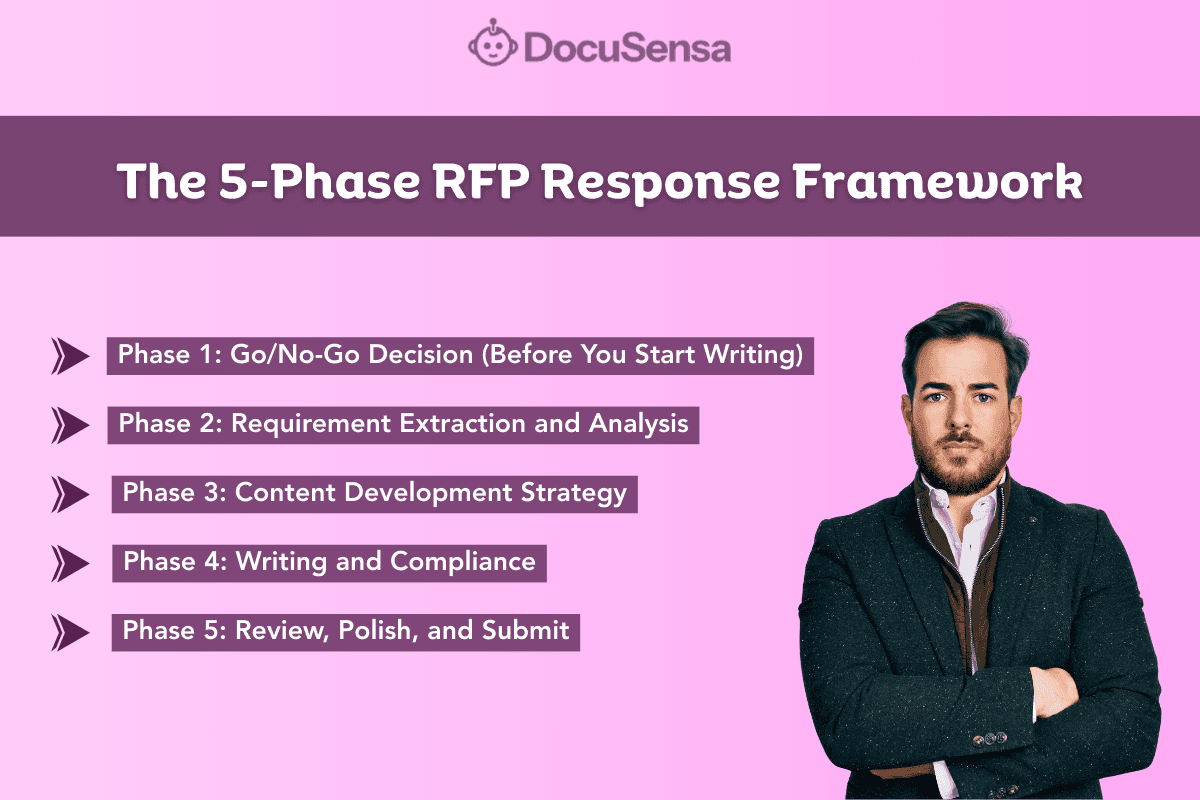
Winning RFP responses don't happen by accident. They're the result of a disciplined process that balances speed with strategy, compliance with creativity. Here's the framework top-performing teams use:
Phase 1: Go/No-Go Decision (Before You Start Writing)
The most important decision isn't how to write your RFP response—it's whether you should respond at all.
Smart teams use a qualification framework before investing resources:
Evaluate These Factors:
Relationship Strength: Do you have an existing relationship with the buyer? Cold RFPs have significantly lower win rates.
Solution Fit: Can you meet all mandatory requirements without major compromises?
Win Probability: Based on evaluation criteria, do you have a competitive advantage?
Resource Availability: Can your team deliver a quality response by the deadline?
Strategic Value: Even if the probability is lower, does this opportunity open doors to future business?
The Decision: If you score poorly across these factors, declining allows you to focus resources on higher-probability opportunities. A "no-bid" decision is often the smartest strategic move.
Phase 2: Requirement Extraction and Analysis
Once you've committed to responding, your first task is understanding exactly what the buyer wants.
Extract Every Requirement:
The average RFP contains 180-300 distinct requirements scattered across multiple sections. Missing even one mandatory item can disqualify your proposal.
Traditional teams spend 2-3 days manually reading and highlighting requirements. Modern teams leverage AI-powered platforms to extract every "shall," "must," and "required" statement automatically—completing this phase in minutes instead of days.
Build Your Compliance Matrix:
A compliance matrix is your roadmap. It maps every requirement to your response, ensuring nothing falls through the cracks.
Your matrix should include:
Requirement ID and description
Mandatory vs. optional classification
Your compliance status (fully compliant, partially compliant, non-compliant)
Response location (which section addresses it)
Supporting documentation needed
Identify Evaluation Criteria:
Understanding how you'll be scored is critical. If the technical approach is worth 50% of the evaluation but price is only 20%, you know where to focus your effort.
Look for:
Weighted scoring criteria
Evaluation factors and their relative importance
Differentiating factors that favor your solution
Phase 3: Content Development Strategy
With requirements mapped, it's time to craft your response strategy.
Develop Your Win Themes:
A win theme is your answer to "Why us?" It should be clear, compelling, and woven throughout your proposal.
Strong win themes are:
Specific: "Fastest implementation in the industry: live in 30 days" beats "quick deployment"
Relevant: Addresses the buyer's primary pain point
Provable: Backed by data, case studies, or testimonials
Gather Your Proof Points:
Every claim needs evidence. Collect:
Case Studies: Similar clients, similar challenges, measurable results
Performance Data: Uptime statistics, speed metrics, customer satisfaction scores
Testimonials: Direct quotes from satisfied customers
Certifications: Security credentials, industry certifications, compliance documentation
Assign Section Ownership:
Divide the proposal into logical sections and assign clear ownership:
Executive Summary → Proposal Manager
Technical Approach → Technical Lead
Pricing → Finance Team
Past Performance → Sales/Account Management
Compliance → Legal/Compliance Officer
Clear ownership prevents gaps and duplicated effort.
Phase 4: Writing and Compliance
Now comes the actual writing. Here's how to structure a winning RFP response:
Start with the Executive Summary:
Many evaluators read only the executive summary. Make it count.
A powerful executive summary follows this formula:
Acknowledge the Challenge: Show you understand their problem
Present Your Solution: Clearly state your approach
Quantify the Value: Specific benefits they'll receive
Establish Credibility: Why you're the right partner
Keep it concise—typically 1-2 pages maximum.
Write Benefit-Focused Content:
Buyers don't care about features. They care about outcomes.
Transform features into benefits:
❌ "Our platform has real-time analytics"
✅ "Real-time analytics give you instant visibility into performance, enabling data-driven decisions that reduce response time by 40%"
Address Requirements Directly:
For each requirement, provide:
Clear Response: Yes/No/Partial compliance
Explanation: How you meet the requirement
Evidence: Proof points supporting your claim
Reference: Where evaluators can find additional detail
Maintain Consistent Messaging:
Your proposal should speak with one voice. Ensure:
Terminology is consistent throughout
Claims align across all sections
Tone matches the buyer's culture (formal for government, conversational for startups)
Automated Compliance Checking:
Before submission, verify you've addressed every requirement. Manual checking is time-consuming and error-prone. AI-powered compliance tools can scan your entire proposal, flagging any missing responses and highlighting potential gaps—turning a multi-day review into a 10-minute verification.
Phase 5: Review, Polish, and Submit
Your first draft is never your final draft.
Multi-Stage Review Process:
Implement these review cycles:
Pink Team Review (Mid-Process):
Purpose: Validate strategy and approach
Timing: 50% complete
Focus: Win themes, compliance, overall structure
Red Team Review (Final Polish):
Purpose: Evaluate as if you're the buyer
Timing: 95% complete
Focus: Clarity, persuasiveness, compliance
Gold Team Review (Executive Sign-Off):
Purpose: Final approval and risk assessment
Timing: 100% complete
Focus: Strategic fit, pricing approval, contractual terms
Final Quality Checks:
Before hitting submit, verify:
All requirements addressed in compliance matrix
Page limits respected
Formatting matches RFP instructions
All appendices included
Submission method correct (portal, email, physical copy)
Deadline met (submit early if possible)
Post-Submission Follow-Up:
Your work isn't done when you submit. Plan your follow-up:
Send confirmation email to buyer
Prepare for potential clarification questions
Ready your team for presentations or demonstrations
Document lessons learned for future RFPs
Common RFP Response Mistakes to Avoid
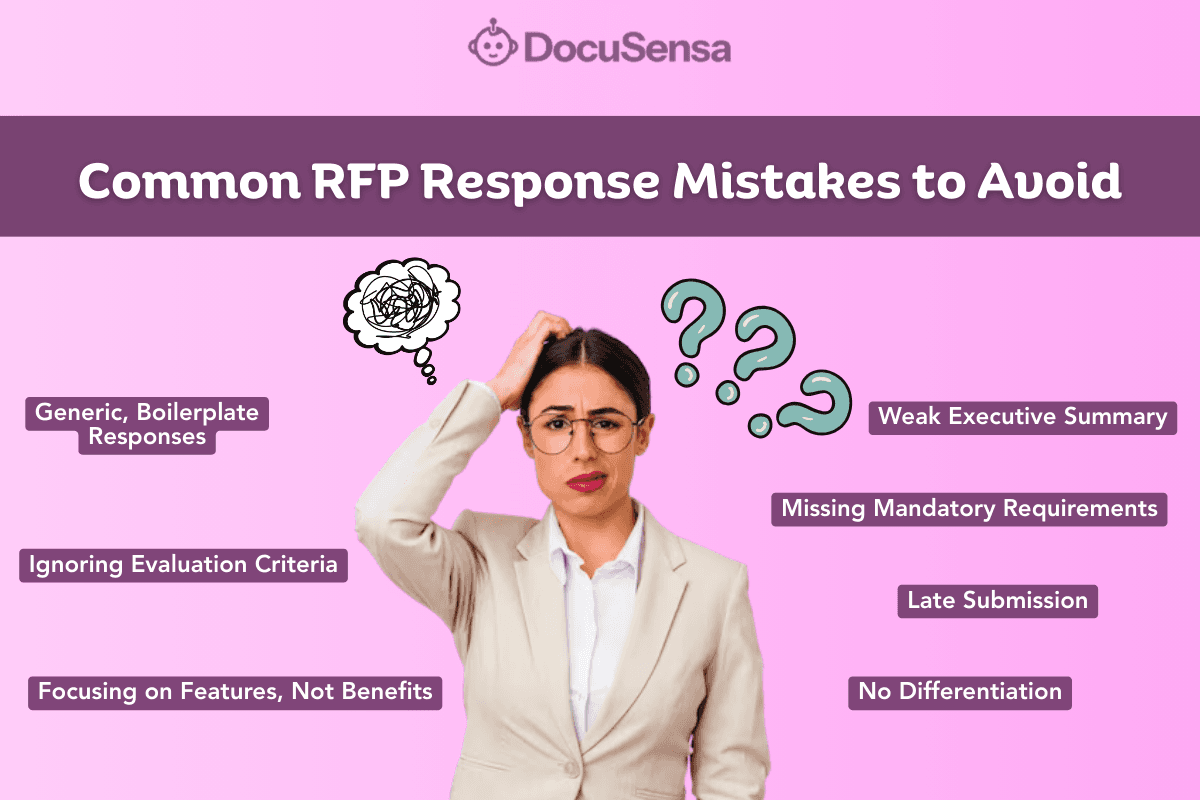
Even experienced teams make critical errors that cost them wins:
1. Generic, Boilerplate Responses
Buyers can spot copy-paste proposals immediately. Every response should be customized to the specific buyer's needs, industry, and evaluation criteria.
2. Focusing on Features, Not Benefits
Listing what your product does is table stakes. Winning proposals show how those capabilities translate into measurable value for the buyer.
3. Missing Mandatory Requirements
A single missed "shall" statement can disqualify an otherwise perfect proposal. Systematic compliance checking is non-negotiable.
4. Weak Executive Summary
If decision-makers only read one section, this is it. Invest the time to make it compelling.
5. Late Submission
Late means disqualified. Build buffer time into your schedule. Aim to submit 24 hours early.
6. Ignoring Evaluation Criteria
If you write an amazing technical section but the price is weighted 70%, you've misallocated your effort. Let evaluation criteria guide your focus.
7. No Differentiation
If your proposal could be submitted by any competitor, you haven't differentiated. What makes you uniquely qualified?

How Modern Teams Accelerate RFP Response Time
The traditional RFP response process is slow, manual, and resource-intensive. Teams spend 80% of their time on administrative tasks—extracting requirements, searching for content, building compliance matrices—leaving only 20% for strategic differentiation.
AI-powered RFP platforms flip this equation.
Automated Requirement Extraction:
Instead of spending days manually reading RFPs, AI can extract every requirement in minutes. This gives your team an immediate head start and ensures nothing is missed.
Intelligent Content Suggestions:
Modern platforms can search your knowledge base and suggest relevant case studies, technical specifications, and past responses based on the RFP's requirements. What used to take hours of searching happens instantly.
AI-Assisted Drafting:
While human expertise remains essential for strategy and customization, AI can generate first drafts for standard sections—company background, team credentials, implementation timelines—freeing your experts to focus on differentiation.
Real-Time Compliance Checking:
As you write, AI monitors compliance, flagging unanswered requirements and highlighting gaps. This transforms compliance from a stressful pre-submission scramble into an ongoing, manageable process.
Platforms like DocuSensa combine these capabilities into a complete RFP response system. Teams report cutting response time by 70-90%, not by working faster, but by eliminating administrative bottlenecks that used to consume most of their time.
Building Your Response Toolkit
Consistent RFP success requires more than just a process—it requires the right resources:
Content Library:
Maintain a repository of reusable content:
Company overview and history
Team biographies and credentials
Technical architecture descriptions
Case studies and customer testimonials
Security and compliance documentation
Standard terms and conditions
Template Library:
Pre-built templates for common sections ensure consistency and speed:
Executive summary templates
Pricing presentation formats
Implementation timeline frameworks
Risk mitigation matrices
Collaboration Platform:
Distributed teams need centralized workspaces for:
Document version control
Real-time collaboration
Comment and review functionality
Approval workflows
When these resources are powered by AI—with intelligent search, automated suggestions, and smart content matching—your response quality improves while your timeline shrinks.
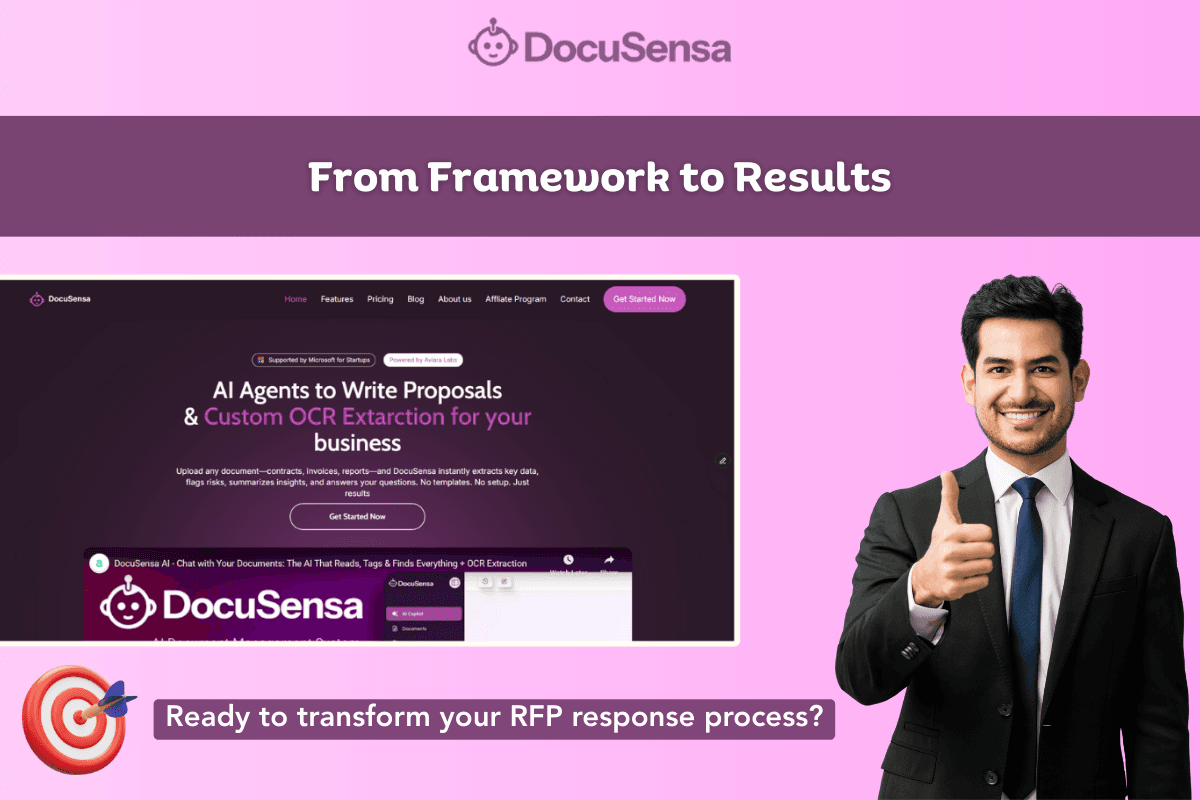
From Framework to Results
Writing winning RFP responses is a skill that improves with practice and systematization. The framework outlined here—qualification, extraction, strategy, writing, and review—provides the structure top-performing teams use to consistently win business.
The key differentiator isn't working harder. It's working smarter by:
Eliminating administrative bottlenecks through automation
Focusing expert time on differentiation and strategy
Ensuring compliance through systematic checking
Building reusable content that improves over time
As RFP volumes increase and deadlines compress, teams that still rely on manual processes will fall behind. Those that embrace AI-powered automation will win more deals with less stress.
Ready to transform your RFP response process?
Discover how DocuSensa helps teams write winning proposals faster. Our AI-powered platform automates requirement extraction, compliance checking, and content suggestions—so your team can focus on crafting compelling, differentiated responses.
Table of Content |
|---|
The 5-Phase RFP Response Framework |
Phase 1: Go/No-Go Decision (Before You Start Writing) |
Phase 2: Requirement Extraction and Analysis |
Phase 3: Content Development Strategy |
Phase 4: Writing and Compliance |
Phase 5: Review, Polish, and Submit |
Common RFP Response Mistakes to Avoid |
How Modern Teams Accelerate RFP Response Time |
Building Your Response Toolkit |
From Framework to Results |
How to Write a Winning RFP Response: A Step-by-Step Framework
You've just received a high-value RFP. Your team is excited—this could be a game-changing contract. But within hours, reality sets in: 200 pages of requirements, a tight 30-day deadline, and the knowledge that a dozen competitors are receiving the same opportunity.
The difference between winning and losing often comes down to how you respond. According to industry data, organizations with a structured RFP response framework win 40% more deals than those working without a system. Yet most teams still approach each RFP as if they're starting from scratch.
This guide provides a proven framework for how to write RFP responses that consistently win business. Whether you're responding to your first RFP or your hundredth, these strategies will help you create compelling, compliant proposals that stand out from the competition.
The 5-Phase RFP Response Framework
Winning RFP responses don't happen by accident. They're the result of a disciplined process that balances speed with strategy, compliance with creativity. Here's the framework top-performing teams use:
Phase 1: Go/No-Go Decision (Before You Start Writing)
The most important decision isn't how to write your RFP response—it's whether you should respond at all.
Smart teams use a qualification framework before investing resources:
Evaluate These Factors:
Relationship Strength: Do you have an existing relationship with the buyer? Cold RFPs have significantly lower win rates.
Solution Fit: Can you meet all mandatory requirements without major compromises?
Win Probability: Based on evaluation criteria, do you have a competitive advantage?
Resource Availability: Can your team deliver a quality response by the deadline?
Strategic Value: Even if the probability is lower, does this opportunity open doors to future business?
The Decision: If you score poorly across these factors, declining allows you to focus resources on higher-probability opportunities. A "no-bid" decision is often the smartest strategic move.
Phase 2: Requirement Extraction and Analysis
Once you've committed to responding, your first task is understanding exactly what the buyer wants.
Extract Every Requirement:
The average RFP contains 180-300 distinct requirements scattered across multiple sections. Missing even one mandatory item can disqualify your proposal.
Traditional teams spend 2-3 days manually reading and highlighting requirements. Modern teams leverage AI-powered platforms to extract every "shall," "must," and "required" statement automatically—completing this phase in minutes instead of days.
Build Your Compliance Matrix:
A compliance matrix is your roadmap. It maps every requirement to your response, ensuring nothing falls through the cracks.
Your matrix should include:
Requirement ID and description
Mandatory vs. optional classification
Your compliance status (fully compliant, partially compliant, non-compliant)
Response location (which section addresses it)
Supporting documentation needed
Identify Evaluation Criteria:
Understanding how you'll be scored is critical. If the technical approach is worth 50% of the evaluation but price is only 20%, you know where to focus your effort.
Look for:
Weighted scoring criteria
Evaluation factors and their relative importance
Differentiating factors that favor your solution
Phase 3: Content Development Strategy
With requirements mapped, it's time to craft your response strategy.
Develop Your Win Themes:
A win theme is your answer to "Why us?" It should be clear, compelling, and woven throughout your proposal.
Strong win themes are:
Specific: "Fastest implementation in the industry: live in 30 days" beats "quick deployment"
Relevant: Addresses the buyer's primary pain point
Provable: Backed by data, case studies, or testimonials
Gather Your Proof Points:
Every claim needs evidence. Collect:
Case Studies: Similar clients, similar challenges, measurable results
Performance Data: Uptime statistics, speed metrics, customer satisfaction scores
Testimonials: Direct quotes from satisfied customers
Certifications: Security credentials, industry certifications, compliance documentation
Assign Section Ownership:
Divide the proposal into logical sections and assign clear ownership:
Executive Summary → Proposal Manager
Technical Approach → Technical Lead
Pricing → Finance Team
Past Performance → Sales/Account Management
Compliance → Legal/Compliance Officer
Clear ownership prevents gaps and duplicated effort.
Phase 4: Writing and Compliance
Now comes the actual writing. Here's how to structure a winning RFP response:
Start with the Executive Summary:
Many evaluators read only the executive summary. Make it count.
A powerful executive summary follows this formula:
Acknowledge the Challenge: Show you understand their problem
Present Your Solution: Clearly state your approach
Quantify the Value: Specific benefits they'll receive
Establish Credibility: Why you're the right partner
Keep it concise—typically 1-2 pages maximum.
Write Benefit-Focused Content:
Buyers don't care about features. They care about outcomes.
Transform features into benefits:
❌ "Our platform has real-time analytics"
✅ "Real-time analytics give you instant visibility into performance, enabling data-driven decisions that reduce response time by 40%"
Address Requirements Directly:
For each requirement, provide:
Clear Response: Yes/No/Partial compliance
Explanation: How you meet the requirement
Evidence: Proof points supporting your claim
Reference: Where evaluators can find additional detail
Maintain Consistent Messaging:
Your proposal should speak with one voice. Ensure:
Terminology is consistent throughout
Claims align across all sections
Tone matches the buyer's culture (formal for government, conversational for startups)
Automated Compliance Checking:
Before submission, verify you've addressed every requirement. Manual checking is time-consuming and error-prone. AI-powered compliance tools can scan your entire proposal, flagging any missing responses and highlighting potential gaps—turning a multi-day review into a 10-minute verification.
Phase 5: Review, Polish, and Submit
Your first draft is never your final draft.
Multi-Stage Review Process:
Implement these review cycles:
Pink Team Review (Mid-Process):
Purpose: Validate strategy and approach
Timing: 50% complete
Focus: Win themes, compliance, overall structure
Red Team Review (Final Polish):
Purpose: Evaluate as if you're the buyer
Timing: 95% complete
Focus: Clarity, persuasiveness, compliance
Gold Team Review (Executive Sign-Off):
Purpose: Final approval and risk assessment
Timing: 100% complete
Focus: Strategic fit, pricing approval, contractual terms
Final Quality Checks:
Before hitting submit, verify:
All requirements addressed in compliance matrix
Page limits respected
Formatting matches RFP instructions
All appendices included
Submission method correct (portal, email, physical copy)
Deadline met (submit early if possible)
Post-Submission Follow-Up:
Your work isn't done when you submit. Plan your follow-up:
Send confirmation email to buyer
Prepare for potential clarification questions
Ready your team for presentations or demonstrations
Document lessons learned for future RFPs
Common RFP Response Mistakes to Avoid
Even experienced teams make critical errors that cost them wins:
1. Generic, Boilerplate Responses
Buyers can spot copy-paste proposals immediately. Every response should be customized to the specific buyer's needs, industry, and evaluation criteria.
2. Focusing on Features, Not Benefits
Listing what your product does is table stakes. Winning proposals show how those capabilities translate into measurable value for the buyer.
3. Missing Mandatory Requirements
A single missed "shall" statement can disqualify an otherwise perfect proposal. Systematic compliance checking is non-negotiable.
4. Weak Executive Summary
If decision-makers only read one section, this is it. Invest the time to make it compelling.
5. Late Submission
Late means disqualified. Build buffer time into your schedule. Aim to submit 24 hours early.
6. Ignoring Evaluation Criteria
If you write an amazing technical section but the price is weighted 70%, you've misallocated your effort. Let evaluation criteria guide your focus.
7. No Differentiation
If your proposal could be submitted by any competitor, you haven't differentiated. What makes you uniquely qualified?
How Modern Teams Accelerate RFP Response Time
The traditional RFP response process is slow, manual, and resource-intensive. Teams spend 80% of their time on administrative tasks—extracting requirements, searching for content, building compliance matrices—leaving only 20% for strategic differentiation.
AI-powered RFP platforms flip this equation.
Automated Requirement Extraction:
Instead of spending days manually reading RFPs, AI can extract every requirement in minutes. This gives your team an immediate head start and ensures nothing is missed.
Intelligent Content Suggestions:
Modern platforms can search your knowledge base and suggest relevant case studies, technical specifications, and past responses based on the RFP's requirements. What used to take hours of searching happens instantly.
AI-Assisted Drafting:
While human expertise remains essential for strategy and customization, AI can generate first drafts for standard sections—company background, team credentials, implementation timelines—freeing your experts to focus on differentiation.
Real-Time Compliance Checking:
As you write, AI monitors compliance, flagging unanswered requirements and highlighting gaps. This transforms compliance from a stressful pre-submission scramble into an ongoing, manageable process.
Platforms like DocuSensa combine these capabilities into a complete RFP response system. Teams report cutting response time by 70-90%, not by working faster, but by eliminating administrative bottlenecks that used to consume most of their time.
Building Your Response Toolkit
Consistent RFP success requires more than just a process—it requires the right resources:
Content Library:
Maintain a repository of reusable content:
Company overview and history
Team biographies and credentials
Technical architecture descriptions
Case studies and customer testimonials
Security and compliance documentation
Standard terms and conditions
Template Library:
Pre-built templates for common sections ensure consistency and speed:
Executive summary templates
Pricing presentation formats
Implementation timeline frameworks
Risk mitigation matrices
Collaboration Platform:
Distributed teams need centralized workspaces for:
Document version control
Real-time collaboration
Comment and review functionality
Approval workflows
When these resources are powered by AI—with intelligent search, automated suggestions, and smart content matching—your response quality improves while your timeline shrinks.
From Framework to Results
Writing winning RFP responses is a skill that improves with practice and systematization. The framework outlined here—qualification, extraction, strategy, writing, and review—provides the structure top-performing teams use to consistently win business.
The key differentiator isn't working harder. It's working smarter by:
Eliminating administrative bottlenecks through automation
Focusing expert time on differentiation and strategy
Ensuring compliance through systematic checking
Building reusable content that improves over time
As RFP volumes increase and deadlines compress, teams that still rely on manual processes will fall behind. Those that embrace AI-powered automation will win more deals with less stress.
Ready to transform your RFP response process?
Discover how DocuSensa helps teams write winning proposals faster. Our AI-powered platform automates requirement extraction, compliance checking, and content suggestions—so your team can focus on crafting compelling, differentiated responses.
Table of Content |
|---|
The 5-Phase RFP Response Framework |
Phase 1: Go/No-Go Decision (Before You Start Writing) |
Phase 2: Requirement Extraction and Analysis |
Phase 3: Content Development Strategy |
Phase 4: Writing and Compliance |
Phase 5: Review, Polish, and Submit |
Common RFP Response Mistakes to Avoid |
How Modern Teams Accelerate RFP Response Time |
Building Your Response Toolkit |
From Framework to Results |
How to Write a Winning RFP Response: A Step-by-Step Framework
You've just received a high-value RFP. Your team is excited—this could be a game-changing contract. But within hours, reality sets in: 200 pages of requirements, a tight 30-day deadline, and the knowledge that a dozen competitors are receiving the same opportunity.
The difference between winning and losing often comes down to how you respond. According to industry data, organizations with a structured RFP response framework win 40% more deals than those working without a system. Yet most teams still approach each RFP as if they're starting from scratch.
This guide provides a proven framework for how to write RFP responses that consistently win business. Whether you're responding to your first RFP or your hundredth, these strategies will help you create compelling, compliant proposals that stand out from the competition.
The 5-Phase RFP Response Framework
Winning RFP responses don't happen by accident. They're the result of a disciplined process that balances speed with strategy, compliance with creativity. Here's the framework top-performing teams use:
Phase 1: Go/No-Go Decision (Before You Start Writing)
The most important decision isn't how to write your RFP response—it's whether you should respond at all.
Smart teams use a qualification framework before investing resources:
Evaluate These Factors:
Relationship Strength: Do you have an existing relationship with the buyer? Cold RFPs have significantly lower win rates.
Solution Fit: Can you meet all mandatory requirements without major compromises?
Win Probability: Based on evaluation criteria, do you have a competitive advantage?
Resource Availability: Can your team deliver a quality response by the deadline?
Strategic Value: Even if the probability is lower, does this opportunity open doors to future business?
The Decision: If you score poorly across these factors, declining allows you to focus resources on higher-probability opportunities. A "no-bid" decision is often the smartest strategic move.
Phase 2: Requirement Extraction and Analysis
Once you've committed to responding, your first task is understanding exactly what the buyer wants.
Extract Every Requirement:
The average RFP contains 180-300 distinct requirements scattered across multiple sections. Missing even one mandatory item can disqualify your proposal.
Traditional teams spend 2-3 days manually reading and highlighting requirements. Modern teams leverage AI-powered platforms to extract every "shall," "must," and "required" statement automatically—completing this phase in minutes instead of days.
Build Your Compliance Matrix:
A compliance matrix is your roadmap. It maps every requirement to your response, ensuring nothing falls through the cracks.
Your matrix should include:
Requirement ID and description
Mandatory vs. optional classification
Your compliance status (fully compliant, partially compliant, non-compliant)
Response location (which section addresses it)
Supporting documentation needed
Identify Evaluation Criteria:
Understanding how you'll be scored is critical. If the technical approach is worth 50% of the evaluation but price is only 20%, you know where to focus your effort.
Look for:
Weighted scoring criteria
Evaluation factors and their relative importance
Differentiating factors that favor your solution
Phase 3: Content Development Strategy
With requirements mapped, it's time to craft your response strategy.
Develop Your Win Themes:
A win theme is your answer to "Why us?" It should be clear, compelling, and woven throughout your proposal.
Strong win themes are:
Specific: "Fastest implementation in the industry: live in 30 days" beats "quick deployment"
Relevant: Addresses the buyer's primary pain point
Provable: Backed by data, case studies, or testimonials
Gather Your Proof Points:
Every claim needs evidence. Collect:
Case Studies: Similar clients, similar challenges, measurable results
Performance Data: Uptime statistics, speed metrics, customer satisfaction scores
Testimonials: Direct quotes from satisfied customers
Certifications: Security credentials, industry certifications, compliance documentation
Assign Section Ownership:
Divide the proposal into logical sections and assign clear ownership:
Executive Summary → Proposal Manager
Technical Approach → Technical Lead
Pricing → Finance Team
Past Performance → Sales/Account Management
Compliance → Legal/Compliance Officer
Clear ownership prevents gaps and duplicated effort.
Phase 4: Writing and Compliance
Now comes the actual writing. Here's how to structure a winning RFP response:
Start with the Executive Summary:
Many evaluators read only the executive summary. Make it count.
A powerful executive summary follows this formula:
Acknowledge the Challenge: Show you understand their problem
Present Your Solution: Clearly state your approach
Quantify the Value: Specific benefits they'll receive
Establish Credibility: Why you're the right partner
Keep it concise—typically 1-2 pages maximum.
Write Benefit-Focused Content:
Buyers don't care about features. They care about outcomes.
Transform features into benefits:
❌ "Our platform has real-time analytics"
✅ "Real-time analytics give you instant visibility into performance, enabling data-driven decisions that reduce response time by 40%"
Address Requirements Directly:
For each requirement, provide:
Clear Response: Yes/No/Partial compliance
Explanation: How you meet the requirement
Evidence: Proof points supporting your claim
Reference: Where evaluators can find additional detail
Maintain Consistent Messaging:
Your proposal should speak with one voice. Ensure:
Terminology is consistent throughout
Claims align across all sections
Tone matches the buyer's culture (formal for government, conversational for startups)
Automated Compliance Checking:
Before submission, verify you've addressed every requirement. Manual checking is time-consuming and error-prone. AI-powered compliance tools can scan your entire proposal, flagging any missing responses and highlighting potential gaps—turning a multi-day review into a 10-minute verification.
Phase 5: Review, Polish, and Submit
Your first draft is never your final draft.
Multi-Stage Review Process:
Implement these review cycles:
Pink Team Review (Mid-Process):
Purpose: Validate strategy and approach
Timing: 50% complete
Focus: Win themes, compliance, overall structure
Red Team Review (Final Polish):
Purpose: Evaluate as if you're the buyer
Timing: 95% complete
Focus: Clarity, persuasiveness, compliance
Gold Team Review (Executive Sign-Off):
Purpose: Final approval and risk assessment
Timing: 100% complete
Focus: Strategic fit, pricing approval, contractual terms
Final Quality Checks:
Before hitting submit, verify:
All requirements addressed in compliance matrix
Page limits respected
Formatting matches RFP instructions
All appendices included
Submission method correct (portal, email, physical copy)
Deadline met (submit early if possible)
Post-Submission Follow-Up:
Your work isn't done when you submit. Plan your follow-up:
Send confirmation email to buyer
Prepare for potential clarification questions
Ready your team for presentations or demonstrations
Document lessons learned for future RFPs
Common RFP Response Mistakes to Avoid
Even experienced teams make critical errors that cost them wins:
1. Generic, Boilerplate Responses
Buyers can spot copy-paste proposals immediately. Every response should be customized to the specific buyer's needs, industry, and evaluation criteria.
2. Focusing on Features, Not Benefits
Listing what your product does is table stakes. Winning proposals show how those capabilities translate into measurable value for the buyer.
3. Missing Mandatory Requirements
A single missed "shall" statement can disqualify an otherwise perfect proposal. Systematic compliance checking is non-negotiable.
4. Weak Executive Summary
If decision-makers only read one section, this is it. Invest the time to make it compelling.
5. Late Submission
Late means disqualified. Build buffer time into your schedule. Aim to submit 24 hours early.
6. Ignoring Evaluation Criteria
If you write an amazing technical section but the price is weighted 70%, you've misallocated your effort. Let evaluation criteria guide your focus.
7. No Differentiation
If your proposal could be submitted by any competitor, you haven't differentiated. What makes you uniquely qualified?
How Modern Teams Accelerate RFP Response Time
The traditional RFP response process is slow, manual, and resource-intensive. Teams spend 80% of their time on administrative tasks—extracting requirements, searching for content, building compliance matrices—leaving only 20% for strategic differentiation.
AI-powered RFP platforms flip this equation.
Automated Requirement Extraction:
Instead of spending days manually reading RFPs, AI can extract every requirement in minutes. This gives your team an immediate head start and ensures nothing is missed.
Intelligent Content Suggestions:
Modern platforms can search your knowledge base and suggest relevant case studies, technical specifications, and past responses based on the RFP's requirements. What used to take hours of searching happens instantly.
AI-Assisted Drafting:
While human expertise remains essential for strategy and customization, AI can generate first drafts for standard sections—company background, team credentials, implementation timelines—freeing your experts to focus on differentiation.
Real-Time Compliance Checking:
As you write, AI monitors compliance, flagging unanswered requirements and highlighting gaps. This transforms compliance from a stressful pre-submission scramble into an ongoing, manageable process.
Platforms like DocuSensa combine these capabilities into a complete RFP response system. Teams report cutting response time by 70-90%, not by working faster, but by eliminating administrative bottlenecks that used to consume most of their time.
Building Your Response Toolkit
Consistent RFP success requires more than just a process—it requires the right resources:
Content Library:
Maintain a repository of reusable content:
Company overview and history
Team biographies and credentials
Technical architecture descriptions
Case studies and customer testimonials
Security and compliance documentation
Standard terms and conditions
Template Library:
Pre-built templates for common sections ensure consistency and speed:
Executive summary templates
Pricing presentation formats
Implementation timeline frameworks
Risk mitigation matrices
Collaboration Platform:
Distributed teams need centralized workspaces for:
Document version control
Real-time collaboration
Comment and review functionality
Approval workflows
When these resources are powered by AI—with intelligent search, automated suggestions, and smart content matching—your response quality improves while your timeline shrinks.
From Framework to Results
Writing winning RFP responses is a skill that improves with practice and systematization. The framework outlined here—qualification, extraction, strategy, writing, and review—provides the structure top-performing teams use to consistently win business.
The key differentiator isn't working harder. It's working smarter by:
Eliminating administrative bottlenecks through automation
Focusing expert time on differentiation and strategy
Ensuring compliance through systematic checking
Building reusable content that improves over time
As RFP volumes increase and deadlines compress, teams that still rely on manual processes will fall behind. Those that embrace AI-powered automation will win more deals with less stress.
Ready to transform your RFP response process?
Discover how DocuSensa helps teams write winning proposals faster. Our AI-powered platform automates requirement extraction, compliance checking, and content suggestions—so your team can focus on crafting compelling, differentiated responses.
Table of Content |
|---|
The 5-Phase RFP Response Framework |
Phase 1: Go/No-Go Decision (Before You Start Writing) |
Phase 2: Requirement Extraction and Analysis |
Phase 3: Content Development Strategy |
Phase 4: Writing and Compliance |
Phase 5: Review, Polish, and Submit |
Common RFP Response Mistakes to Avoid |
How Modern Teams Accelerate RFP Response Time |
Building Your Response Toolkit |
From Framework to Results |
How to Write a Winning RFP Response: A Step-by-Step Framework
You've just received a high-value RFP. Your team is excited—this could be a game-changing contract. But within hours, reality sets in: 200 pages of requirements, a tight 30-day deadline, and the knowledge that a dozen competitors are receiving the same opportunity.
The difference between winning and losing often comes down to how you respond. According to industry data, organizations with a structured RFP response framework win 40% more deals than those working without a system. Yet most teams still approach each RFP as if they're starting from scratch.
This guide provides a proven framework for how to write RFP responses that consistently win business. Whether you're responding to your first RFP or your hundredth, these strategies will help you create compelling, compliant proposals that stand out from the competition.
The 5-Phase RFP Response Framework
Winning RFP responses don't happen by accident. They're the result of a disciplined process that balances speed with strategy, compliance with creativity. Here's the framework top-performing teams use:
Phase 1: Go/No-Go Decision (Before You Start Writing)
The most important decision isn't how to write your RFP response—it's whether you should respond at all.
Smart teams use a qualification framework before investing resources:
Evaluate These Factors:
Relationship Strength: Do you have an existing relationship with the buyer? Cold RFPs have significantly lower win rates.
Solution Fit: Can you meet all mandatory requirements without major compromises?
Win Probability: Based on evaluation criteria, do you have a competitive advantage?
Resource Availability: Can your team deliver a quality response by the deadline?
Strategic Value: Even if the probability is lower, does this opportunity open doors to future business?
The Decision: If you score poorly across these factors, declining allows you to focus resources on higher-probability opportunities. A "no-bid" decision is often the smartest strategic move.
Phase 2: Requirement Extraction and Analysis
Once you've committed to responding, your first task is understanding exactly what the buyer wants.
Extract Every Requirement:
The average RFP contains 180-300 distinct requirements scattered across multiple sections. Missing even one mandatory item can disqualify your proposal.
Traditional teams spend 2-3 days manually reading and highlighting requirements. Modern teams leverage AI-powered platforms to extract every "shall," "must," and "required" statement automatically—completing this phase in minutes instead of days.
Build Your Compliance Matrix:
A compliance matrix is your roadmap. It maps every requirement to your response, ensuring nothing falls through the cracks.
Your matrix should include:
Requirement ID and description
Mandatory vs. optional classification
Your compliance status (fully compliant, partially compliant, non-compliant)
Response location (which section addresses it)
Supporting documentation needed
Identify Evaluation Criteria:
Understanding how you'll be scored is critical. If the technical approach is worth 50% of the evaluation but price is only 20%, you know where to focus your effort.
Look for:
Weighted scoring criteria
Evaluation factors and their relative importance
Differentiating factors that favor your solution
Phase 3: Content Development Strategy
With requirements mapped, it's time to craft your response strategy.
Develop Your Win Themes:
A win theme is your answer to "Why us?" It should be clear, compelling, and woven throughout your proposal.
Strong win themes are:
Specific: "Fastest implementation in the industry: live in 30 days" beats "quick deployment"
Relevant: Addresses the buyer's primary pain point
Provable: Backed by data, case studies, or testimonials
Gather Your Proof Points:
Every claim needs evidence. Collect:
Case Studies: Similar clients, similar challenges, measurable results
Performance Data: Uptime statistics, speed metrics, customer satisfaction scores
Testimonials: Direct quotes from satisfied customers
Certifications: Security credentials, industry certifications, compliance documentation
Assign Section Ownership:
Divide the proposal into logical sections and assign clear ownership:
Executive Summary → Proposal Manager
Technical Approach → Technical Lead
Pricing → Finance Team
Past Performance → Sales/Account Management
Compliance → Legal/Compliance Officer
Clear ownership prevents gaps and duplicated effort.
Phase 4: Writing and Compliance
Now comes the actual writing. Here's how to structure a winning RFP response:
Start with the Executive Summary:
Many evaluators read only the executive summary. Make it count.
A powerful executive summary follows this formula:
Acknowledge the Challenge: Show you understand their problem
Present Your Solution: Clearly state your approach
Quantify the Value: Specific benefits they'll receive
Establish Credibility: Why you're the right partner
Keep it concise—typically 1-2 pages maximum.
Write Benefit-Focused Content:
Buyers don't care about features. They care about outcomes.
Transform features into benefits:
❌ "Our platform has real-time analytics"
✅ "Real-time analytics give you instant visibility into performance, enabling data-driven decisions that reduce response time by 40%"
Address Requirements Directly:
For each requirement, provide:
Clear Response: Yes/No/Partial compliance
Explanation: How you meet the requirement
Evidence: Proof points supporting your claim
Reference: Where evaluators can find additional detail
Maintain Consistent Messaging:
Your proposal should speak with one voice. Ensure:
Terminology is consistent throughout
Claims align across all sections
Tone matches the buyer's culture (formal for government, conversational for startups)
Automated Compliance Checking:
Before submission, verify you've addressed every requirement. Manual checking is time-consuming and error-prone. AI-powered compliance tools can scan your entire proposal, flagging any missing responses and highlighting potential gaps—turning a multi-day review into a 10-minute verification.
Phase 5: Review, Polish, and Submit
Your first draft is never your final draft.
Multi-Stage Review Process:
Implement these review cycles:
Pink Team Review (Mid-Process):
Purpose: Validate strategy and approach
Timing: 50% complete
Focus: Win themes, compliance, overall structure
Red Team Review (Final Polish):
Purpose: Evaluate as if you're the buyer
Timing: 95% complete
Focus: Clarity, persuasiveness, compliance
Gold Team Review (Executive Sign-Off):
Purpose: Final approval and risk assessment
Timing: 100% complete
Focus: Strategic fit, pricing approval, contractual terms
Final Quality Checks:
Before hitting submit, verify:
All requirements addressed in compliance matrix
Page limits respected
Formatting matches RFP instructions
All appendices included
Submission method correct (portal, email, physical copy)
Deadline met (submit early if possible)
Post-Submission Follow-Up:
Your work isn't done when you submit. Plan your follow-up:
Send confirmation email to buyer
Prepare for potential clarification questions
Ready your team for presentations or demonstrations
Document lessons learned for future RFPs
Common RFP Response Mistakes to Avoid
Even experienced teams make critical errors that cost them wins:
1. Generic, Boilerplate Responses
Buyers can spot copy-paste proposals immediately. Every response should be customized to the specific buyer's needs, industry, and evaluation criteria.
2. Focusing on Features, Not Benefits
Listing what your product does is table stakes. Winning proposals show how those capabilities translate into measurable value for the buyer.
3. Missing Mandatory Requirements
A single missed "shall" statement can disqualify an otherwise perfect proposal. Systematic compliance checking is non-negotiable.
4. Weak Executive Summary
If decision-makers only read one section, this is it. Invest the time to make it compelling.
5. Late Submission
Late means disqualified. Build buffer time into your schedule. Aim to submit 24 hours early.
6. Ignoring Evaluation Criteria
If you write an amazing technical section but the price is weighted 70%, you've misallocated your effort. Let evaluation criteria guide your focus.
7. No Differentiation
If your proposal could be submitted by any competitor, you haven't differentiated. What makes you uniquely qualified?
How Modern Teams Accelerate RFP Response Time
The traditional RFP response process is slow, manual, and resource-intensive. Teams spend 80% of their time on administrative tasks—extracting requirements, searching for content, building compliance matrices—leaving only 20% for strategic differentiation.
AI-powered RFP platforms flip this equation.
Automated Requirement Extraction:
Instead of spending days manually reading RFPs, AI can extract every requirement in minutes. This gives your team an immediate head start and ensures nothing is missed.
Intelligent Content Suggestions:
Modern platforms can search your knowledge base and suggest relevant case studies, technical specifications, and past responses based on the RFP's requirements. What used to take hours of searching happens instantly.
AI-Assisted Drafting:
While human expertise remains essential for strategy and customization, AI can generate first drafts for standard sections—company background, team credentials, implementation timelines—freeing your experts to focus on differentiation.
Real-Time Compliance Checking:
As you write, AI monitors compliance, flagging unanswered requirements and highlighting gaps. This transforms compliance from a stressful pre-submission scramble into an ongoing, manageable process.
Platforms like DocuSensa combine these capabilities into a complete RFP response system. Teams report cutting response time by 70-90%, not by working faster, but by eliminating administrative bottlenecks that used to consume most of their time.
Building Your Response Toolkit
Consistent RFP success requires more than just a process—it requires the right resources:
Content Library:
Maintain a repository of reusable content:
Company overview and history
Team biographies and credentials
Technical architecture descriptions
Case studies and customer testimonials
Security and compliance documentation
Standard terms and conditions
Template Library:
Pre-built templates for common sections ensure consistency and speed:
Executive summary templates
Pricing presentation formats
Implementation timeline frameworks
Risk mitigation matrices
Collaboration Platform:
Distributed teams need centralized workspaces for:
Document version control
Real-time collaboration
Comment and review functionality
Approval workflows
When these resources are powered by AI—with intelligent search, automated suggestions, and smart content matching—your response quality improves while your timeline shrinks.
From Framework to Results
Writing winning RFP responses is a skill that improves with practice and systematization. The framework outlined here—qualification, extraction, strategy, writing, and review—provides the structure top-performing teams use to consistently win business.
The key differentiator isn't working harder. It's working smarter by:
Eliminating administrative bottlenecks through automation
Focusing expert time on differentiation and strategy
Ensuring compliance through systematic checking
Building reusable content that improves over time
As RFP volumes increase and deadlines compress, teams that still rely on manual processes will fall behind. Those that embrace AI-powered automation will win more deals with less stress.
Ready to transform your RFP response process?
Discover how DocuSensa helps teams write winning proposals faster. Our AI-powered platform automates requirement extraction, compliance checking, and content suggestions—so your team can focus on crafting compelling, differentiated responses.
Want more insights like this?
Want more insights like this?
Want more insights like this?
DocuSensa helps teams write faster, smarter Proposals with AI
DocuSensa helps teams write faster, smarter Proposals with AI
DocuSensa helps teams write faster, smarter Proposals with AI
Schedule a Call
Schedule a Call
Schedule a Call