Guide to RFP
Jan 20, 2026
Table of Content |
|---|
What is an RFP? A Clear Definition |
RFP vs RFQ vs RFI vs SOW |
Who Issues RFPs and Why |
Pre-RFP Planning: Settings Up for Success |
The 8- Step RFP Process: From Planning to Contract |
RFP Templates: Accelerating Your Process |
Technology and Tools : Streamlining RFP Management |
Best Practices for RFP Success |
Common Pitfalls and How to Avoid Them |
Your RFP Action Plan |
RFP Steps & Template: The Complete Guide to Requests for Proposals
Every year, organizations worldwide issue over $500 billion in RFPs. Yet, 73% of businesses lose these opportunities—not because they lack capability, but because they misunderstand the process. Whether you're issuing your first RFP or managing your hundredth response, the difference between success and failure often comes down to understanding the fundamentals and having the right framework. This guide breaks down everything you need to know about Requests for Proposals: what they are, when to use them, and how to execute them effectively.
What Is an RFP? A Clear Definition
A Request for Proposal (RFP) is a formal business document issued by an organization to solicit competitive bids from qualified vendors for a specific project or service. Unlike simple price quotes, an RFP asks vendors to propose how they would solve a problem, what methodology they'd use, and what value they'd deliver.
The Legal and Practical Reality
RFPs typically exist in a legal gray area. In private sector transactions, the RFP itself is generally not legally binding—it's an invitation to submit offers. The binding contract comes later, after selection and negotiation. However, in government procurement, your RFP response often becomes part of the final contract, making accuracy critical from the start.
The distinction matters internationally as well. US federal RFPs follow strict Federal Acquisition Regulation (FAR) guidelines. EU public procurement operates under different directives. Understanding these variations prevents costly mistakes when pursuing opportunities across borders.
RFP vs. RFQ vs. RFI vs. SOW: Understanding the Differences
The procurement world runs on acronyms. Confusing them costs time and resources. Here's what separates each document type:
RFP (Request for Proposal): The buyer has a problem and wants your solution approach, methodology, and team credentials. Think: "We need to migrate our CRM system—show us how you'd do it."
RFQ (Request for Quotation): The buyer knows exactly what they want and needs pricing. Think: "We need 500 software licenses—what's your price per seat?"
RFI (Request for Information): The buyer is researching what's possible before committing. Think: "We're exploring AI solutions for our archive—what capabilities exist in the market?"
SOW (Statement of Work): This comes after vendor selection and defines the specific deliverables, timeline, and activities for the project.
Misidentifying these documents means allocating the wrong resources. Responding to an RFI with a 50-page proposal wastes effort. Treating an RFP like a simple pricing exercise loses you the deal.
Who Issues RFPs and Why
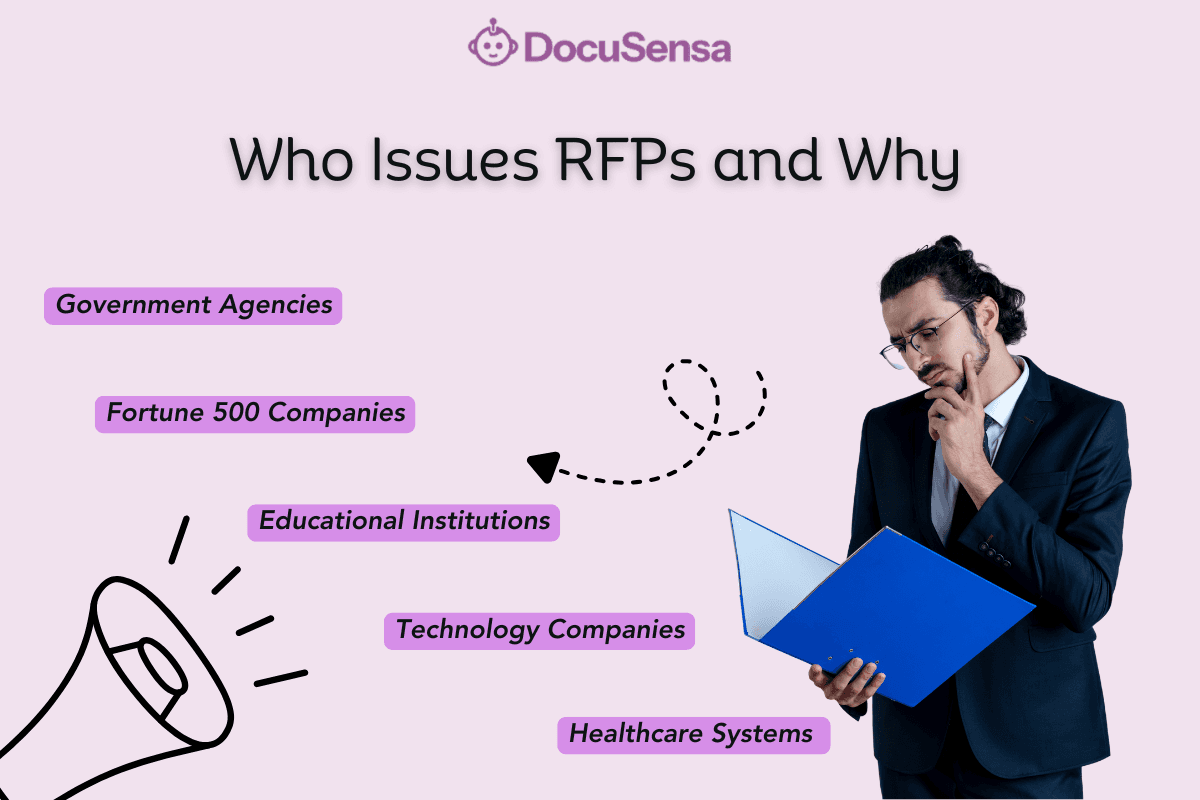
RFPs span nearly every industry and organization size, though certain sectors rely on them more heavily:
Government Agencies issue RFPs for infrastructure, technology systems, consulting services, and public works. Federal agencies alone account for hundreds of billions in annual RFP volume, with strict compliance requirements under FAR regulations.
Fortune 500 Companies use RFPs to procure enterprise software, strategic consulting, marketing campaigns, and outsourced services. These typically involve multiple stakeholder approval processes and rigorous evaluation criteria.
Healthcare Systems issue RFPs for electronic health records (EHR), medical equipment, facility management, and compliance services. HIPAA requirements add complexity to these procurements.
Educational Institutions rely on RFPs for curriculum software, campus security systems, construction projects, and research equipment.
Technology Companies use RFPs to select cloud providers, development partners, and marketing automation platforms—often with tight integration requirements.
Understanding who's issuing the RFP shapes your response strategy. Government RFPs prioritize strict compliance. Corporate RFPs emphasize ROI and implementation speed. Healthcare RFPs require security certifications.
Pre-RFP Planning: Setting Up for Success
Before drafting an RFP, successful organizations complete thorough groundwork:
Needs Assessment: Define the problem you're solving. What's broken? What business outcome must improve? Vague requirements produce vague proposals.
Budget Determination: Establish realistic budget parameters. This prevents wasting vendor time on proposals that exceed your financial capacity.
Stakeholder Alignment: Get buy-in from everyone affected by the decision—IT, finance, legal, and end users. Misaligned stakeholders derail projects post-award.
Market Research: Understand what solutions exist, typical pricing ranges, and industry standards. This prevents unrealistic expectations.
Vendor Identification: Create a qualified vendor list based on capability, reputation, and relevant experience. Pre-qualifying vendors improves response quality.
Timeline Development: Work backward from your project start date. Allow adequate time for vendor responses, evaluation, negotiation, and contract execution.
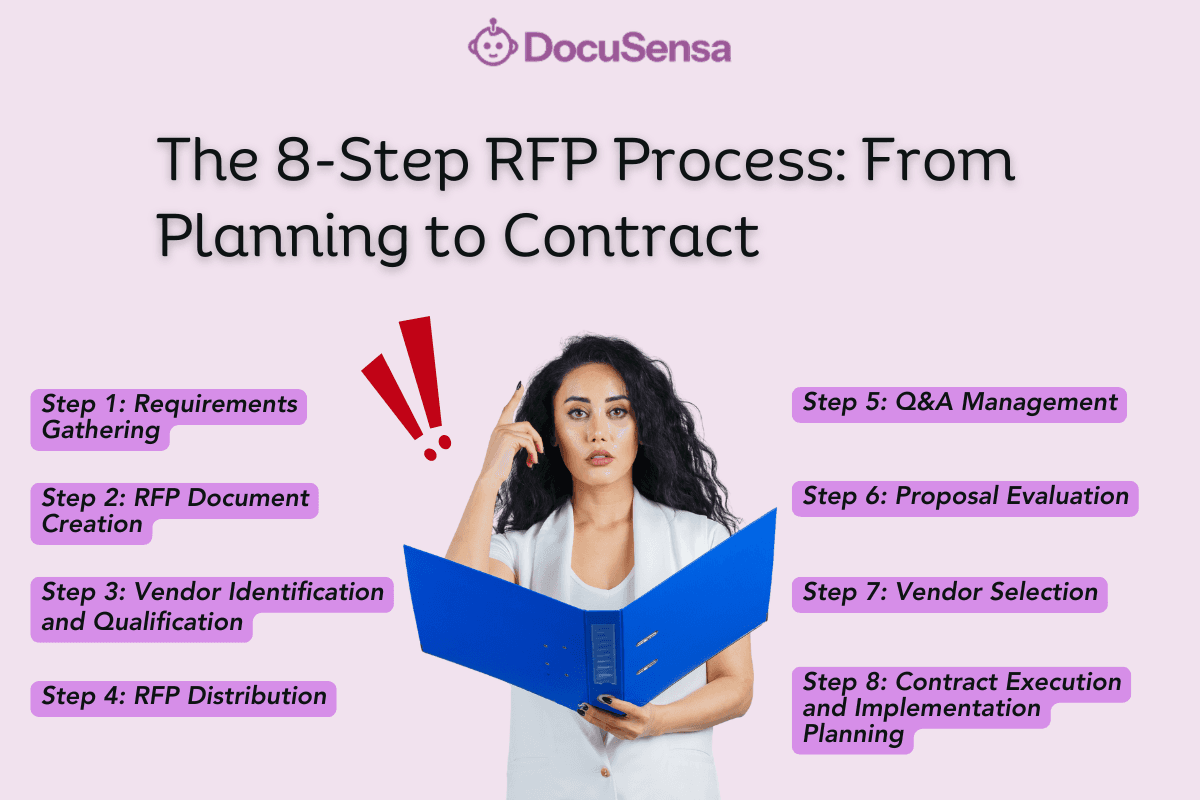
The 8-Step RFP Process: From Planning to Contract
Step 1: Requirements Gathering
Comprehensive requirements prevent scope creep and vendor confusion.
Stakeholder Interviews: Talk to everyone who'll use the solution. Their daily pain points reveal requirements that executives might miss.
Current State Analysis: Document existing processes, systems, and challenges. This baseline helps vendors understand your starting point.
Future State Vision: Describe what success looks like. Specific, measurable outcomes guide better proposals.
Technical Requirements: List integration needs, security protocols, performance benchmarks, and scalability requirements. Be specific—"must integrate with Salesforce via REST API" beats "should work with our CRM."
Business Requirements: Define implementation timeline, training needs, support expectations, and change management approach.
Compliance Needs: Identify regulatory requirements (SOC 2, HIPAA, GDPR) and industry certifications vendors must hold.
Step 2: RFP Document Creation
A well-structured RFP gets better responses. Include these core sections:
Executive Summary: Briefly describe your organization, the project, and the opportunity. This orients vendors before they dive into details.
Company Background: Provide context about your business, industry position, and relevant operational details.
Project Scope: Define what's included and explicitly state what's excluded. Clear boundaries prevent scope disputes later.
Deliverables: List specific outputs vendors must provide—software modules, reports, training materials, documentation.
Timeline: Include RFP release date, Q&A deadline, proposal due date, evaluation period, and expected contract start date.
Evaluation Criteria: Specify how you'll score proposals. Assign weights to different factors (technical approach: 40%, price: 30%, experience: 20%, etc.).
Terms and Conditions: Cover payment terms, intellectual property rights, liability limits, and contract duration.
Step 3: Vendor Identification and Qualification
Strategic vendor selection improves response quality.
Market Research: Identify potential vendors through industry associations, peer recommendations, analyst reports, and online research.
Vendor Databases: Leverage platforms like SAM.gov (for government contractors) or industry-specific vendor directories.
Pre-Qualification Criteria: Screen vendors based on minimum requirements: revenue size, years in business, relevant certifications, geographic presence.
Shortlist Creation: Limit RFP distribution to qualified vendors who genuinely match your needs. Too many vendors dilutes the pool; too few limits competition.
Step 4: RFP Distribution
How you distribute the RFP affects vendor engagement.
Public Posting: Government RFPs typically require public posting on procurement portals. This ensures fair access and compliance with regulations.
Direct Invitations: For private sector RFPs, you can invite specific vendors directly. This often produces higher-quality responses from vendors who understand your business context.
Confidentiality Agreements: Require NDAs when the RFP contains sensitive business information or proprietary data.
Communication Protocols: Establish rules for vendor communication. Designate a single point of contact and prohibit side conversations to ensure fairness.
Step 5: Q&A Management
The Q&A period clarifies ambiguities and ensures vendors have the information needed for accurate proposals.
Pre-Bid Conference: Host an optional meeting where vendors can ask questions in real-time. This builds relationships and surfaces issues early.
Written Q&A Process: Accept written questions by a specific deadline. Compile answers and distribute them to all vendors simultaneously to maintain fairness.
Amendment Procedures: If questions reveal RFP errors or needed clarifications, issue formal amendments. Track amendment versions carefully.
Clarification Deadlines: Set cutoff dates for questions. This gives vendors time to incorporate answers while preserving your evaluation timeline.
Information Sharing Rules: Share all Q&A responses with every vendor. Selective disclosure creates unfair advantages.
Step 6: Proposal Evaluation
Structured evaluation prevents bias and ensures you select the best vendor.
Evaluation Team Assembly: Include stakeholders from relevant departments: technical leads, finance, procurement, legal, and end users.
Scoring Methodology: Use the weighted criteria defined in your RFP. Assign numerical scores to each proposal section.
Technical Evaluation: Assess whether proposed solutions meet requirements, their implementation approach, risk mitigation strategies, and innovation.
Price Evaluation: Compare total cost of ownership, not just initial price. Include implementation costs, training, maintenance, and hidden fees.
Reference Checks: Contact past clients to verify vendor claims about performance, reliability, and support quality.
Site Visits or Demos: For complex projects, request product demonstrations or visit reference sites to validate capabilities.
Step 7: Vendor Selection
The selection phase balances objective scoring with strategic fit.
Selection Criteria Review: Revisit your weighted evaluation criteria. Ensure the top-scoring vendor genuinely aligns with your strategic needs.
Negotiation Strategy: Prepare your negotiation position. Identify must-haves versus nice-to-haves. Understand your BATNA (Best Alternative to Negotiated Agreement).
Best and Final Offers (BAFO): Request final pricing and terms from finalists. This competitive pressure often improves deal terms.
Contract Terms: Negotiate payment schedules, performance guarantees, SLAs, termination clauses, and intellectual property rights.
Risk Assessment: Evaluate vendor financial stability, client concentration, key person dependencies, and business continuity plans.
Final Decision Process: Document your selection rationale. This protects against challenges and provides a clear audit trail.
Step 8: Contract Execution and Implementation Planning
Closing the deal sets the foundation for project success.
Contract Negotiation: Finalize legal terms, liabilities, warranties, and dispute resolution procedures. Involve legal counsel for complex agreements.
Terms Finalization: Confirm scope, deliverables, timeline, payment schedule, and change order processes in writing.
Implementation Planning: Develop a detailed project plan with milestones, resource allocation, and dependencies before project kickoff.
Performance Metrics: Define KPIs and success metrics. Establish how you'll measure vendor performance against commitments.
Governance Structure: Assign project leads, establish meeting cadence, define escalation paths, and create decision-making frameworks.
RFP Templates: Accelerating Your Process
Starting from scratch wastes time. Using proven templates ensures completeness and consistency.
Standard RFP Template: A general-purpose template covering common sections applicable across industries. Customize for your specific needs.
IT Services Template: Tailored for technology procurements with sections on system architecture, integration requirements, security protocols, and technical support.
Construction Template: Includes project specifications, materials requirements, safety protocols, insurance requirements, and permitting responsibilities.
Consulting Template: Emphasizes methodology, team qualifications, deliverables, knowledge transfer, and engagement models.
Marketing Template: Covers campaign strategy, creative deliverables, performance metrics, channel expertise, and reporting cadence.
Annotated Examples: Templates with inline guidance explaining what to include in each section and common pitfalls to avoid.
Customization Best Practices
Templates provide structure, but customization makes them effective:
Industry-Specific Language: Adapt terminology to your sector. Healthcare RFPs use different language than manufacturing RFPs.
Your Evaluation Criteria: Adjust scoring weights to reflect your priorities. Cost-sensitive projects weigh price higher; innovation-driven projects prioritize technical approach.
Relevant Compliance Requirements: Include only applicable regulations. Don't copy-paste HIPAA requirements into a marketing RFP.
Your Timeline Reality: Set realistic deadlines based on your decision-making process, not arbitrary dates.
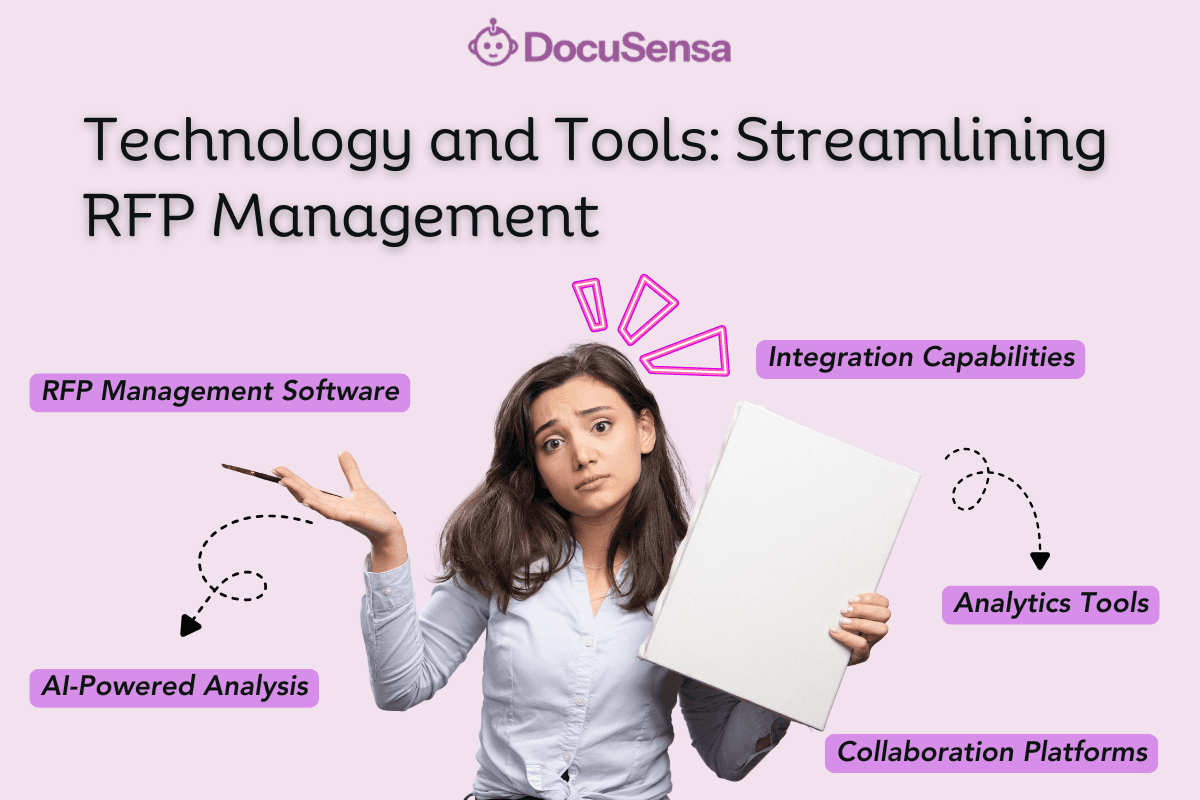
Technology and Tools: Streamlining RFP Management
Modern RFP processes leverage technology to improve efficiency and accuracy.
RFP Management Software: Platforms that centralize document distribution, vendor communication, proposal submission, and evaluation scoring.
Collaboration Platforms: Tools enabling cross-functional teams to review proposals, share feedback, and make decisions asynchronously.
AI-Powered Analysis: Advanced platforms like DocuSensa automatically extract requirements from RFPs, flag compliance gaps, generate compliance matrices, and suggest responses from your content library. This automation reduces manual analysis time by up to 70% while improving accuracy.
Analytics Tools: Software that tracks RFP metrics—response rates, time-to-decision, vendor performance, and contract outcomes. These insights refine future RFP processes.
Integration Capabilities: Solutions that connect with your existing tech stack—CRM systems, procurement platforms, contract management tools, and e-signature services.
The DocuSensa Advantage
DocuSensa transforms RFP management from manual grind to strategic workflow:
Automated Data Extraction: Instantly pull key requirements, deadlines, evaluation criteria, and submission instructions from any RFP format.
Risk Flagging: AI identifies potentially problematic clauses—liability terms, payment conditions, or non-standard requirements—before you invest response time.
Intelligent Summarization: Generate concise summaries for stakeholders who need to understand scope without reading 200-page documents.
Compliance Matrix Automation: Automatically map RFP requirements to your response sections, ensuring nothing gets missed.
Content Library Integration: Pull best-performing answers from past proposals, maintaining consistency while customizing for each opportunity.
Best Practices for RFP Success
For RFP Issuers:
Do:
Define clear, measurable evaluation criteria upfront
Provide realistic timelines that respect vendor capacity
Answer vendor questions thoroughly during Q&A
Communicate decisions transparently to all participants
Document your selection rationale for audit trails
Don't:
Write vague requirements that allow multiple interpretations
Set unrealistic deadlines that force rushed, low-quality responses
Change requirements mid-process without formal amendments
Favor incumbent vendors through biased evaluation
Ghost vendors after submission without feedback
For RFP Responders:
Do:
Conduct rigorous go/no-go analysis before committing resources
Follow submission instructions precisely—formatting, delivery method, deadline
Address every requirement in your compliance matrix
Provide specific, quantified benefits rather than generic claims
Proofread thoroughly—typos signal carelessness
Don't:
Submit generic, boilerplate proposals copied from previous responses
Focus on features instead of client-specific benefits
Make claims without supporting evidence (case studies, data, testimonials)
Miss mandatory requirements—even one gap can disqualify you
Submit late—most procurement systems automatically reject late submissions
Timeline Recommendations:
Small projects (<$100K): 3-4 weeks for RFP response
Mid-size projects ($100K-$1M): 6-8 weeks for RFP response
Large projects (>$1M): 10-12 weeks for RFP response
Evaluation period: 2-4 weeks depending on proposal complexity
Negotiation and contract finalization: 2-6 weeks
Common Pitfalls and How to Avoid Them
Unrealistic Scope: Organizations often underestimate project complexity, leading to budget overruns and timeline delays. Conduct thorough needs assessments and build contingency buffers.
Evaluation Bias: Familiarity with incumbent vendors can skew scores. Use blind evaluation for initial scoring and structured rubrics to maintain objectivity.
Communication Breakdowns: Poor Q&A management creates vendor confusion and low-quality proposals. Designate a dedicated RFP manager and establish clear communication protocols.
Legal Oversights: Missing critical contract terms (liability caps, IP ownership, termination rights) creates disputes later. Involve legal counsel early in RFP drafting.
Analysis Paralysis: Perfectionism delays decisions and frustrates vendors. Set decision deadlines and trust your evaluation framework.

Conclusion: Your RFP Action Plan
Mastering the RFP process—whether issuing or responding—requires structured methodology, clear communication, and the right tools.
Your immediate next steps:
Download the RFP template most relevant to your industry from this guide
Audit your current process against the best practices outlined here—identify gaps and improvement opportunities
Establish evaluation criteria that genuinely reflect your priorities before your next RFP
Explore automation tools like DocuSensa to eliminate manual work and improve accuracy
The RFP process doesn't have to be a resource drain. With proper planning, structured workflows, and intelligent automation, it becomes a strategic advantage—helping you select better vendors, negotiate better terms, and deliver better business outcomes.
Ready to transform your RFP process?
Experience how DocuSensa's AI-powered platform streamlines requirement extraction, automates compliance tracking, and accelerates proposal creation. Start your free trial today and join 500+ teams already saving 20+ hours weekly on RFP management.
Table of Content |
|---|
What is an RFP? A Clear Definition |
RFP vs RFQ vs RFI vs SOW |
Who Issues RFPs and Why |
Pre-RFP Planning: Settings Up for Success |
The 8- Step RFP Process: From Planning to Contract |
RFP Templates: Accelerating Your Process |
Technology and Tools : Streamlining RFP Management |
Best Practices for RFP Success |
Common Pitfalls and How to Avoid Them |
Your RFP Action Plan |
RFP Steps & Template: The Complete Guide to Requests for Proposals
Every year, organizations worldwide issue over $500 billion in RFPs. Yet, 73% of businesses lose these opportunities—not because they lack capability, but because they misunderstand the process. Whether you're issuing your first RFP or managing your hundredth response, the difference between success and failure often comes down to understanding the fundamentals and having the right framework. This guide breaks down everything you need to know about Requests for Proposals: what they are, when to use them, and how to execute them effectively.
What Is an RFP? A Clear Definition
A Request for Proposal (RFP) is a formal business document issued by an organization to solicit competitive bids from qualified vendors for a specific project or service. Unlike simple price quotes, an RFP asks vendors to propose how they would solve a problem, what methodology they'd use, and what value they'd deliver.
The Legal and Practical Reality
RFPs typically exist in a legal gray area. In private sector transactions, the RFP itself is generally not legally binding—it's an invitation to submit offers. The binding contract comes later, after selection and negotiation. However, in government procurement, your RFP response often becomes part of the final contract, making accuracy critical from the start.
The distinction matters internationally as well. US federal RFPs follow strict Federal Acquisition Regulation (FAR) guidelines. EU public procurement operates under different directives. Understanding these variations prevents costly mistakes when pursuing opportunities across borders.
RFP vs. RFQ vs. RFI vs. SOW: Understanding the Differences
The procurement world runs on acronyms. Confusing them costs time and resources. Here's what separates each document type:
RFP (Request for Proposal): The buyer has a problem and wants your solution approach, methodology, and team credentials. Think: "We need to migrate our CRM system—show us how you'd do it."
RFQ (Request for Quotation): The buyer knows exactly what they want and needs pricing. Think: "We need 500 software licenses—what's your price per seat?"
RFI (Request for Information): The buyer is researching what's possible before committing. Think: "We're exploring AI solutions for our archive—what capabilities exist in the market?"
SOW (Statement of Work): This comes after vendor selection and defines the specific deliverables, timeline, and activities for the project.
Misidentifying these documents means allocating the wrong resources. Responding to an RFI with a 50-page proposal wastes effort. Treating an RFP like a simple pricing exercise loses you the deal.
Who Issues RFPs and Why
RFPs span nearly every industry and organization size, though certain sectors rely on them more heavily:
Government Agencies issue RFPs for infrastructure, technology systems, consulting services, and public works. Federal agencies alone account for hundreds of billions in annual RFP volume, with strict compliance requirements under FAR regulations.
Fortune 500 Companies use RFPs to procure enterprise software, strategic consulting, marketing campaigns, and outsourced services. These typically involve multiple stakeholder approval processes and rigorous evaluation criteria.
Healthcare Systems issue RFPs for electronic health records (EHR), medical equipment, facility management, and compliance services. HIPAA requirements add complexity to these procurements.
Educational Institutions rely on RFPs for curriculum software, campus security systems, construction projects, and research equipment.
Technology Companies use RFPs to select cloud providers, development partners, and marketing automation platforms—often with tight integration requirements.
Understanding who's issuing the RFP shapes your response strategy. Government RFPs prioritize strict compliance. Corporate RFPs emphasize ROI and implementation speed. Healthcare RFPs require security certifications.
Pre-RFP Planning: Setting Up for Success
Before drafting an RFP, successful organizations complete thorough groundwork:
Needs Assessment: Define the problem you're solving. What's broken? What business outcome must improve? Vague requirements produce vague proposals.
Budget Determination: Establish realistic budget parameters. This prevents wasting vendor time on proposals that exceed your financial capacity.
Stakeholder Alignment: Get buy-in from everyone affected by the decision—IT, finance, legal, and end users. Misaligned stakeholders derail projects post-award.
Market Research: Understand what solutions exist, typical pricing ranges, and industry standards. This prevents unrealistic expectations.
Vendor Identification: Create a qualified vendor list based on capability, reputation, and relevant experience. Pre-qualifying vendors improves response quality.
Timeline Development: Work backward from your project start date. Allow adequate time for vendor responses, evaluation, negotiation, and contract execution.
The 8-Step RFP Process: From Planning to Contract
Step 1: Requirements Gathering
Comprehensive requirements prevent scope creep and vendor confusion.
Stakeholder Interviews: Talk to everyone who'll use the solution. Their daily pain points reveal requirements that executives might miss.
Current State Analysis: Document existing processes, systems, and challenges. This baseline helps vendors understand your starting point.
Future State Vision: Describe what success looks like. Specific, measurable outcomes guide better proposals.
Technical Requirements: List integration needs, security protocols, performance benchmarks, and scalability requirements. Be specific—"must integrate with Salesforce via REST API" beats "should work with our CRM."
Business Requirements: Define implementation timeline, training needs, support expectations, and change management approach.
Compliance Needs: Identify regulatory requirements (SOC 2, HIPAA, GDPR) and industry certifications vendors must hold.
Step 2: RFP Document Creation
A well-structured RFP gets better responses. Include these core sections:
Executive Summary: Briefly describe your organization, the project, and the opportunity. This orients vendors before they dive into details.
Company Background: Provide context about your business, industry position, and relevant operational details.
Project Scope: Define what's included and explicitly state what's excluded. Clear boundaries prevent scope disputes later.
Deliverables: List specific outputs vendors must provide—software modules, reports, training materials, documentation.
Timeline: Include RFP release date, Q&A deadline, proposal due date, evaluation period, and expected contract start date.
Evaluation Criteria: Specify how you'll score proposals. Assign weights to different factors (technical approach: 40%, price: 30%, experience: 20%, etc.).
Terms and Conditions: Cover payment terms, intellectual property rights, liability limits, and contract duration.
Step 3: Vendor Identification and Qualification
Strategic vendor selection improves response quality.
Market Research: Identify potential vendors through industry associations, peer recommendations, analyst reports, and online research.
Vendor Databases: Leverage platforms like SAM.gov (for government contractors) or industry-specific vendor directories.
Pre-Qualification Criteria: Screen vendors based on minimum requirements: revenue size, years in business, relevant certifications, geographic presence.
Shortlist Creation: Limit RFP distribution to qualified vendors who genuinely match your needs. Too many vendors dilutes the pool; too few limits competition.
Step 4: RFP Distribution
How you distribute the RFP affects vendor engagement.
Public Posting: Government RFPs typically require public posting on procurement portals. This ensures fair access and compliance with regulations.
Direct Invitations: For private sector RFPs, you can invite specific vendors directly. This often produces higher-quality responses from vendors who understand your business context.
Confidentiality Agreements: Require NDAs when the RFP contains sensitive business information or proprietary data.
Communication Protocols: Establish rules for vendor communication. Designate a single point of contact and prohibit side conversations to ensure fairness.
Step 5: Q&A Management
The Q&A period clarifies ambiguities and ensures vendors have the information needed for accurate proposals.
Pre-Bid Conference: Host an optional meeting where vendors can ask questions in real-time. This builds relationships and surfaces issues early.
Written Q&A Process: Accept written questions by a specific deadline. Compile answers and distribute them to all vendors simultaneously to maintain fairness.
Amendment Procedures: If questions reveal RFP errors or needed clarifications, issue formal amendments. Track amendment versions carefully.
Clarification Deadlines: Set cutoff dates for questions. This gives vendors time to incorporate answers while preserving your evaluation timeline.
Information Sharing Rules: Share all Q&A responses with every vendor. Selective disclosure creates unfair advantages.
Step 6: Proposal Evaluation
Structured evaluation prevents bias and ensures you select the best vendor.
Evaluation Team Assembly: Include stakeholders from relevant departments: technical leads, finance, procurement, legal, and end users.
Scoring Methodology: Use the weighted criteria defined in your RFP. Assign numerical scores to each proposal section.
Technical Evaluation: Assess whether proposed solutions meet requirements, their implementation approach, risk mitigation strategies, and innovation.
Price Evaluation: Compare total cost of ownership, not just initial price. Include implementation costs, training, maintenance, and hidden fees.
Reference Checks: Contact past clients to verify vendor claims about performance, reliability, and support quality.
Site Visits or Demos: For complex projects, request product demonstrations or visit reference sites to validate capabilities.
Step 7: Vendor Selection
The selection phase balances objective scoring with strategic fit.
Selection Criteria Review: Revisit your weighted evaluation criteria. Ensure the top-scoring vendor genuinely aligns with your strategic needs.
Negotiation Strategy: Prepare your negotiation position. Identify must-haves versus nice-to-haves. Understand your BATNA (Best Alternative to Negotiated Agreement).
Best and Final Offers (BAFO): Request final pricing and terms from finalists. This competitive pressure often improves deal terms.
Contract Terms: Negotiate payment schedules, performance guarantees, SLAs, termination clauses, and intellectual property rights.
Risk Assessment: Evaluate vendor financial stability, client concentration, key person dependencies, and business continuity plans.
Final Decision Process: Document your selection rationale. This protects against challenges and provides a clear audit trail.
Step 8: Contract Execution and Implementation Planning
Closing the deal sets the foundation for project success.
Contract Negotiation: Finalize legal terms, liabilities, warranties, and dispute resolution procedures. Involve legal counsel for complex agreements.
Terms Finalization: Confirm scope, deliverables, timeline, payment schedule, and change order processes in writing.
Implementation Planning: Develop a detailed project plan with milestones, resource allocation, and dependencies before project kickoff.
Performance Metrics: Define KPIs and success metrics. Establish how you'll measure vendor performance against commitments.
Governance Structure: Assign project leads, establish meeting cadence, define escalation paths, and create decision-making frameworks.
RFP Templates: Accelerating Your Process
Starting from scratch wastes time. Using proven templates ensures completeness and consistency.
Standard RFP Template: A general-purpose template covering common sections applicable across industries. Customize for your specific needs.
IT Services Template: Tailored for technology procurements with sections on system architecture, integration requirements, security protocols, and technical support.
Construction Template: Includes project specifications, materials requirements, safety protocols, insurance requirements, and permitting responsibilities.
Consulting Template: Emphasizes methodology, team qualifications, deliverables, knowledge transfer, and engagement models.
Marketing Template: Covers campaign strategy, creative deliverables, performance metrics, channel expertise, and reporting cadence.
Annotated Examples: Templates with inline guidance explaining what to include in each section and common pitfalls to avoid.
Customization Best Practices
Templates provide structure, but customization makes them effective:
Industry-Specific Language: Adapt terminology to your sector. Healthcare RFPs use different language than manufacturing RFPs.
Your Evaluation Criteria: Adjust scoring weights to reflect your priorities. Cost-sensitive projects weigh price higher; innovation-driven projects prioritize technical approach.
Relevant Compliance Requirements: Include only applicable regulations. Don't copy-paste HIPAA requirements into a marketing RFP.
Your Timeline Reality: Set realistic deadlines based on your decision-making process, not arbitrary dates.
Technology and Tools: Streamlining RFP Management
Modern RFP processes leverage technology to improve efficiency and accuracy.
RFP Management Software: Platforms that centralize document distribution, vendor communication, proposal submission, and evaluation scoring.
Collaboration Platforms: Tools enabling cross-functional teams to review proposals, share feedback, and make decisions asynchronously.
AI-Powered Analysis: Advanced platforms like DocuSensa automatically extract requirements from RFPs, flag compliance gaps, generate compliance matrices, and suggest responses from your content library. This automation reduces manual analysis time by up to 70% while improving accuracy.
Analytics Tools: Software that tracks RFP metrics—response rates, time-to-decision, vendor performance, and contract outcomes. These insights refine future RFP processes.
Integration Capabilities: Solutions that connect with your existing tech stack—CRM systems, procurement platforms, contract management tools, and e-signature services.
The DocuSensa Advantage
DocuSensa transforms RFP management from manual grind to strategic workflow:
Automated Data Extraction: Instantly pull key requirements, deadlines, evaluation criteria, and submission instructions from any RFP format.
Risk Flagging: AI identifies potentially problematic clauses—liability terms, payment conditions, or non-standard requirements—before you invest response time.
Intelligent Summarization: Generate concise summaries for stakeholders who need to understand scope without reading 200-page documents.
Compliance Matrix Automation: Automatically map RFP requirements to your response sections, ensuring nothing gets missed.
Content Library Integration: Pull best-performing answers from past proposals, maintaining consistency while customizing for each opportunity.
Best Practices for RFP Success
For RFP Issuers:
Do:
Define clear, measurable evaluation criteria upfront
Provide realistic timelines that respect vendor capacity
Answer vendor questions thoroughly during Q&A
Communicate decisions transparently to all participants
Document your selection rationale for audit trails
Don't:
Write vague requirements that allow multiple interpretations
Set unrealistic deadlines that force rushed, low-quality responses
Change requirements mid-process without formal amendments
Favor incumbent vendors through biased evaluation
Ghost vendors after submission without feedback
For RFP Responders:
Do:
Conduct rigorous go/no-go analysis before committing resources
Follow submission instructions precisely—formatting, delivery method, deadline
Address every requirement in your compliance matrix
Provide specific, quantified benefits rather than generic claims
Proofread thoroughly—typos signal carelessness
Don't:
Submit generic, boilerplate proposals copied from previous responses
Focus on features instead of client-specific benefits
Make claims without supporting evidence (case studies, data, testimonials)
Miss mandatory requirements—even one gap can disqualify you
Submit late—most procurement systems automatically reject late submissions
Timeline Recommendations:
Small projects (<$100K): 3-4 weeks for RFP response
Mid-size projects ($100K-$1M): 6-8 weeks for RFP response
Large projects (>$1M): 10-12 weeks for RFP response
Evaluation period: 2-4 weeks depending on proposal complexity
Negotiation and contract finalization: 2-6 weeks
Common Pitfalls and How to Avoid Them
Unrealistic Scope: Organizations often underestimate project complexity, leading to budget overruns and timeline delays. Conduct thorough needs assessments and build contingency buffers.
Evaluation Bias: Familiarity with incumbent vendors can skew scores. Use blind evaluation for initial scoring and structured rubrics to maintain objectivity.
Communication Breakdowns: Poor Q&A management creates vendor confusion and low-quality proposals. Designate a dedicated RFP manager and establish clear communication protocols.
Legal Oversights: Missing critical contract terms (liability caps, IP ownership, termination rights) creates disputes later. Involve legal counsel early in RFP drafting.
Analysis Paralysis: Perfectionism delays decisions and frustrates vendors. Set decision deadlines and trust your evaluation framework.
Conclusion: Your RFP Action Plan
Mastering the RFP process—whether issuing or responding—requires structured methodology, clear communication, and the right tools.
Your immediate next steps:
Download the RFP template most relevant to your industry from this guide
Audit your current process against the best practices outlined here—identify gaps and improvement opportunities
Establish evaluation criteria that genuinely reflect your priorities before your next RFP
Explore automation tools like DocuSensa to eliminate manual work and improve accuracy
The RFP process doesn't have to be a resource drain. With proper planning, structured workflows, and intelligent automation, it becomes a strategic advantage—helping you select better vendors, negotiate better terms, and deliver better business outcomes.
Ready to transform your RFP process?
Experience how DocuSensa's AI-powered platform streamlines requirement extraction, automates compliance tracking, and accelerates proposal creation. Start your free trial today and join 500+ teams already saving 20+ hours weekly on RFP management.
Table of Content |
|---|
What is an RFP? A Clear Definition |
RFP vs RFQ vs RFI vs SOW |
Who Issues RFPs and Why |
Pre-RFP Planning: Settings Up for Success |
The 8- Step RFP Process: From Planning to Contract |
RFP Templates: Accelerating Your Process |
Technology and Tools : Streamlining RFP Management |
Best Practices for RFP Success |
Common Pitfalls and How to Avoid Them |
Your RFP Action Plan |
RFP Steps & Template: The Complete Guide to Requests for Proposals
Every year, organizations worldwide issue over $500 billion in RFPs. Yet, 73% of businesses lose these opportunities—not because they lack capability, but because they misunderstand the process. Whether you're issuing your first RFP or managing your hundredth response, the difference between success and failure often comes down to understanding the fundamentals and having the right framework. This guide breaks down everything you need to know about Requests for Proposals: what they are, when to use them, and how to execute them effectively.
What Is an RFP? A Clear Definition
A Request for Proposal (RFP) is a formal business document issued by an organization to solicit competitive bids from qualified vendors for a specific project or service. Unlike simple price quotes, an RFP asks vendors to propose how they would solve a problem, what methodology they'd use, and what value they'd deliver.
The Legal and Practical Reality
RFPs typically exist in a legal gray area. In private sector transactions, the RFP itself is generally not legally binding—it's an invitation to submit offers. The binding contract comes later, after selection and negotiation. However, in government procurement, your RFP response often becomes part of the final contract, making accuracy critical from the start.
The distinction matters internationally as well. US federal RFPs follow strict Federal Acquisition Regulation (FAR) guidelines. EU public procurement operates under different directives. Understanding these variations prevents costly mistakes when pursuing opportunities across borders.
RFP vs. RFQ vs. RFI vs. SOW: Understanding the Differences
The procurement world runs on acronyms. Confusing them costs time and resources. Here's what separates each document type:
RFP (Request for Proposal): The buyer has a problem and wants your solution approach, methodology, and team credentials. Think: "We need to migrate our CRM system—show us how you'd do it."
RFQ (Request for Quotation): The buyer knows exactly what they want and needs pricing. Think: "We need 500 software licenses—what's your price per seat?"
RFI (Request for Information): The buyer is researching what's possible before committing. Think: "We're exploring AI solutions for our archive—what capabilities exist in the market?"
SOW (Statement of Work): This comes after vendor selection and defines the specific deliverables, timeline, and activities for the project.
Misidentifying these documents means allocating the wrong resources. Responding to an RFI with a 50-page proposal wastes effort. Treating an RFP like a simple pricing exercise loses you the deal.
Who Issues RFPs and Why
RFPs span nearly every industry and organization size, though certain sectors rely on them more heavily:
Government Agencies issue RFPs for infrastructure, technology systems, consulting services, and public works. Federal agencies alone account for hundreds of billions in annual RFP volume, with strict compliance requirements under FAR regulations.
Fortune 500 Companies use RFPs to procure enterprise software, strategic consulting, marketing campaigns, and outsourced services. These typically involve multiple stakeholder approval processes and rigorous evaluation criteria.
Healthcare Systems issue RFPs for electronic health records (EHR), medical equipment, facility management, and compliance services. HIPAA requirements add complexity to these procurements.
Educational Institutions rely on RFPs for curriculum software, campus security systems, construction projects, and research equipment.
Technology Companies use RFPs to select cloud providers, development partners, and marketing automation platforms—often with tight integration requirements.
Understanding who's issuing the RFP shapes your response strategy. Government RFPs prioritize strict compliance. Corporate RFPs emphasize ROI and implementation speed. Healthcare RFPs require security certifications.
Pre-RFP Planning: Setting Up for Success
Before drafting an RFP, successful organizations complete thorough groundwork:
Needs Assessment: Define the problem you're solving. What's broken? What business outcome must improve? Vague requirements produce vague proposals.
Budget Determination: Establish realistic budget parameters. This prevents wasting vendor time on proposals that exceed your financial capacity.
Stakeholder Alignment: Get buy-in from everyone affected by the decision—IT, finance, legal, and end users. Misaligned stakeholders derail projects post-award.
Market Research: Understand what solutions exist, typical pricing ranges, and industry standards. This prevents unrealistic expectations.
Vendor Identification: Create a qualified vendor list based on capability, reputation, and relevant experience. Pre-qualifying vendors improves response quality.
Timeline Development: Work backward from your project start date. Allow adequate time for vendor responses, evaluation, negotiation, and contract execution.
The 8-Step RFP Process: From Planning to Contract
Step 1: Requirements Gathering
Comprehensive requirements prevent scope creep and vendor confusion.
Stakeholder Interviews: Talk to everyone who'll use the solution. Their daily pain points reveal requirements that executives might miss.
Current State Analysis: Document existing processes, systems, and challenges. This baseline helps vendors understand your starting point.
Future State Vision: Describe what success looks like. Specific, measurable outcomes guide better proposals.
Technical Requirements: List integration needs, security protocols, performance benchmarks, and scalability requirements. Be specific—"must integrate with Salesforce via REST API" beats "should work with our CRM."
Business Requirements: Define implementation timeline, training needs, support expectations, and change management approach.
Compliance Needs: Identify regulatory requirements (SOC 2, HIPAA, GDPR) and industry certifications vendors must hold.
Step 2: RFP Document Creation
A well-structured RFP gets better responses. Include these core sections:
Executive Summary: Briefly describe your organization, the project, and the opportunity. This orients vendors before they dive into details.
Company Background: Provide context about your business, industry position, and relevant operational details.
Project Scope: Define what's included and explicitly state what's excluded. Clear boundaries prevent scope disputes later.
Deliverables: List specific outputs vendors must provide—software modules, reports, training materials, documentation.
Timeline: Include RFP release date, Q&A deadline, proposal due date, evaluation period, and expected contract start date.
Evaluation Criteria: Specify how you'll score proposals. Assign weights to different factors (technical approach: 40%, price: 30%, experience: 20%, etc.).
Terms and Conditions: Cover payment terms, intellectual property rights, liability limits, and contract duration.
Step 3: Vendor Identification and Qualification
Strategic vendor selection improves response quality.
Market Research: Identify potential vendors through industry associations, peer recommendations, analyst reports, and online research.
Vendor Databases: Leverage platforms like SAM.gov (for government contractors) or industry-specific vendor directories.
Pre-Qualification Criteria: Screen vendors based on minimum requirements: revenue size, years in business, relevant certifications, geographic presence.
Shortlist Creation: Limit RFP distribution to qualified vendors who genuinely match your needs. Too many vendors dilutes the pool; too few limits competition.
Step 4: RFP Distribution
How you distribute the RFP affects vendor engagement.
Public Posting: Government RFPs typically require public posting on procurement portals. This ensures fair access and compliance with regulations.
Direct Invitations: For private sector RFPs, you can invite specific vendors directly. This often produces higher-quality responses from vendors who understand your business context.
Confidentiality Agreements: Require NDAs when the RFP contains sensitive business information or proprietary data.
Communication Protocols: Establish rules for vendor communication. Designate a single point of contact and prohibit side conversations to ensure fairness.
Step 5: Q&A Management
The Q&A period clarifies ambiguities and ensures vendors have the information needed for accurate proposals.
Pre-Bid Conference: Host an optional meeting where vendors can ask questions in real-time. This builds relationships and surfaces issues early.
Written Q&A Process: Accept written questions by a specific deadline. Compile answers and distribute them to all vendors simultaneously to maintain fairness.
Amendment Procedures: If questions reveal RFP errors or needed clarifications, issue formal amendments. Track amendment versions carefully.
Clarification Deadlines: Set cutoff dates for questions. This gives vendors time to incorporate answers while preserving your evaluation timeline.
Information Sharing Rules: Share all Q&A responses with every vendor. Selective disclosure creates unfair advantages.
Step 6: Proposal Evaluation
Structured evaluation prevents bias and ensures you select the best vendor.
Evaluation Team Assembly: Include stakeholders from relevant departments: technical leads, finance, procurement, legal, and end users.
Scoring Methodology: Use the weighted criteria defined in your RFP. Assign numerical scores to each proposal section.
Technical Evaluation: Assess whether proposed solutions meet requirements, their implementation approach, risk mitigation strategies, and innovation.
Price Evaluation: Compare total cost of ownership, not just initial price. Include implementation costs, training, maintenance, and hidden fees.
Reference Checks: Contact past clients to verify vendor claims about performance, reliability, and support quality.
Site Visits or Demos: For complex projects, request product demonstrations or visit reference sites to validate capabilities.
Step 7: Vendor Selection
The selection phase balances objective scoring with strategic fit.
Selection Criteria Review: Revisit your weighted evaluation criteria. Ensure the top-scoring vendor genuinely aligns with your strategic needs.
Negotiation Strategy: Prepare your negotiation position. Identify must-haves versus nice-to-haves. Understand your BATNA (Best Alternative to Negotiated Agreement).
Best and Final Offers (BAFO): Request final pricing and terms from finalists. This competitive pressure often improves deal terms.
Contract Terms: Negotiate payment schedules, performance guarantees, SLAs, termination clauses, and intellectual property rights.
Risk Assessment: Evaluate vendor financial stability, client concentration, key person dependencies, and business continuity plans.
Final Decision Process: Document your selection rationale. This protects against challenges and provides a clear audit trail.
Step 8: Contract Execution and Implementation Planning
Closing the deal sets the foundation for project success.
Contract Negotiation: Finalize legal terms, liabilities, warranties, and dispute resolution procedures. Involve legal counsel for complex agreements.
Terms Finalization: Confirm scope, deliverables, timeline, payment schedule, and change order processes in writing.
Implementation Planning: Develop a detailed project plan with milestones, resource allocation, and dependencies before project kickoff.
Performance Metrics: Define KPIs and success metrics. Establish how you'll measure vendor performance against commitments.
Governance Structure: Assign project leads, establish meeting cadence, define escalation paths, and create decision-making frameworks.
RFP Templates: Accelerating Your Process
Starting from scratch wastes time. Using proven templates ensures completeness and consistency.
Standard RFP Template: A general-purpose template covering common sections applicable across industries. Customize for your specific needs.
IT Services Template: Tailored for technology procurements with sections on system architecture, integration requirements, security protocols, and technical support.
Construction Template: Includes project specifications, materials requirements, safety protocols, insurance requirements, and permitting responsibilities.
Consulting Template: Emphasizes methodology, team qualifications, deliverables, knowledge transfer, and engagement models.
Marketing Template: Covers campaign strategy, creative deliverables, performance metrics, channel expertise, and reporting cadence.
Annotated Examples: Templates with inline guidance explaining what to include in each section and common pitfalls to avoid.
Customization Best Practices
Templates provide structure, but customization makes them effective:
Industry-Specific Language: Adapt terminology to your sector. Healthcare RFPs use different language than manufacturing RFPs.
Your Evaluation Criteria: Adjust scoring weights to reflect your priorities. Cost-sensitive projects weigh price higher; innovation-driven projects prioritize technical approach.
Relevant Compliance Requirements: Include only applicable regulations. Don't copy-paste HIPAA requirements into a marketing RFP.
Your Timeline Reality: Set realistic deadlines based on your decision-making process, not arbitrary dates.
Technology and Tools: Streamlining RFP Management
Modern RFP processes leverage technology to improve efficiency and accuracy.
RFP Management Software: Platforms that centralize document distribution, vendor communication, proposal submission, and evaluation scoring.
Collaboration Platforms: Tools enabling cross-functional teams to review proposals, share feedback, and make decisions asynchronously.
AI-Powered Analysis: Advanced platforms like DocuSensa automatically extract requirements from RFPs, flag compliance gaps, generate compliance matrices, and suggest responses from your content library. This automation reduces manual analysis time by up to 70% while improving accuracy.
Analytics Tools: Software that tracks RFP metrics—response rates, time-to-decision, vendor performance, and contract outcomes. These insights refine future RFP processes.
Integration Capabilities: Solutions that connect with your existing tech stack—CRM systems, procurement platforms, contract management tools, and e-signature services.
The DocuSensa Advantage
DocuSensa transforms RFP management from manual grind to strategic workflow:
Automated Data Extraction: Instantly pull key requirements, deadlines, evaluation criteria, and submission instructions from any RFP format.
Risk Flagging: AI identifies potentially problematic clauses—liability terms, payment conditions, or non-standard requirements—before you invest response time.
Intelligent Summarization: Generate concise summaries for stakeholders who need to understand scope without reading 200-page documents.
Compliance Matrix Automation: Automatically map RFP requirements to your response sections, ensuring nothing gets missed.
Content Library Integration: Pull best-performing answers from past proposals, maintaining consistency while customizing for each opportunity.
Best Practices for RFP Success
For RFP Issuers:
Do:
Define clear, measurable evaluation criteria upfront
Provide realistic timelines that respect vendor capacity
Answer vendor questions thoroughly during Q&A
Communicate decisions transparently to all participants
Document your selection rationale for audit trails
Don't:
Write vague requirements that allow multiple interpretations
Set unrealistic deadlines that force rushed, low-quality responses
Change requirements mid-process without formal amendments
Favor incumbent vendors through biased evaluation
Ghost vendors after submission without feedback
For RFP Responders:
Do:
Conduct rigorous go/no-go analysis before committing resources
Follow submission instructions precisely—formatting, delivery method, deadline
Address every requirement in your compliance matrix
Provide specific, quantified benefits rather than generic claims
Proofread thoroughly—typos signal carelessness
Don't:
Submit generic, boilerplate proposals copied from previous responses
Focus on features instead of client-specific benefits
Make claims without supporting evidence (case studies, data, testimonials)
Miss mandatory requirements—even one gap can disqualify you
Submit late—most procurement systems automatically reject late submissions
Timeline Recommendations:
Small projects (<$100K): 3-4 weeks for RFP response
Mid-size projects ($100K-$1M): 6-8 weeks for RFP response
Large projects (>$1M): 10-12 weeks for RFP response
Evaluation period: 2-4 weeks depending on proposal complexity
Negotiation and contract finalization: 2-6 weeks
Common Pitfalls and How to Avoid Them
Unrealistic Scope: Organizations often underestimate project complexity, leading to budget overruns and timeline delays. Conduct thorough needs assessments and build contingency buffers.
Evaluation Bias: Familiarity with incumbent vendors can skew scores. Use blind evaluation for initial scoring and structured rubrics to maintain objectivity.
Communication Breakdowns: Poor Q&A management creates vendor confusion and low-quality proposals. Designate a dedicated RFP manager and establish clear communication protocols.
Legal Oversights: Missing critical contract terms (liability caps, IP ownership, termination rights) creates disputes later. Involve legal counsel early in RFP drafting.
Analysis Paralysis: Perfectionism delays decisions and frustrates vendors. Set decision deadlines and trust your evaluation framework.
Conclusion: Your RFP Action Plan
Mastering the RFP process—whether issuing or responding—requires structured methodology, clear communication, and the right tools.
Your immediate next steps:
Download the RFP template most relevant to your industry from this guide
Audit your current process against the best practices outlined here—identify gaps and improvement opportunities
Establish evaluation criteria that genuinely reflect your priorities before your next RFP
Explore automation tools like DocuSensa to eliminate manual work and improve accuracy
The RFP process doesn't have to be a resource drain. With proper planning, structured workflows, and intelligent automation, it becomes a strategic advantage—helping you select better vendors, negotiate better terms, and deliver better business outcomes.
Ready to transform your RFP process?
Experience how DocuSensa's AI-powered platform streamlines requirement extraction, automates compliance tracking, and accelerates proposal creation. Start your free trial today and join 500+ teams already saving 20+ hours weekly on RFP management.
Table of Content |
|---|
What is an RFP? A Clear Definition |
RFP vs RFQ vs RFI vs SOW |
Who Issues RFPs and Why |
Pre-RFP Planning: Settings Up for Success |
The 8- Step RFP Process: From Planning to Contract |
RFP Templates: Accelerating Your Process |
Technology and Tools : Streamlining RFP Management |
Best Practices for RFP Success |
Common Pitfalls and How to Avoid Them |
Your RFP Action Plan |
RFP Steps & Template: The Complete Guide to Requests for Proposals
Every year, organizations worldwide issue over $500 billion in RFPs. Yet, 73% of businesses lose these opportunities—not because they lack capability, but because they misunderstand the process. Whether you're issuing your first RFP or managing your hundredth response, the difference between success and failure often comes down to understanding the fundamentals and having the right framework. This guide breaks down everything you need to know about Requests for Proposals: what they are, when to use them, and how to execute them effectively.
What Is an RFP? A Clear Definition
A Request for Proposal (RFP) is a formal business document issued by an organization to solicit competitive bids from qualified vendors for a specific project or service. Unlike simple price quotes, an RFP asks vendors to propose how they would solve a problem, what methodology they'd use, and what value they'd deliver.
The Legal and Practical Reality
RFPs typically exist in a legal gray area. In private sector transactions, the RFP itself is generally not legally binding—it's an invitation to submit offers. The binding contract comes later, after selection and negotiation. However, in government procurement, your RFP response often becomes part of the final contract, making accuracy critical from the start.
The distinction matters internationally as well. US federal RFPs follow strict Federal Acquisition Regulation (FAR) guidelines. EU public procurement operates under different directives. Understanding these variations prevents costly mistakes when pursuing opportunities across borders.
RFP vs. RFQ vs. RFI vs. SOW: Understanding the Differences
The procurement world runs on acronyms. Confusing them costs time and resources. Here's what separates each document type:
RFP (Request for Proposal): The buyer has a problem and wants your solution approach, methodology, and team credentials. Think: "We need to migrate our CRM system—show us how you'd do it."
RFQ (Request for Quotation): The buyer knows exactly what they want and needs pricing. Think: "We need 500 software licenses—what's your price per seat?"
RFI (Request for Information): The buyer is researching what's possible before committing. Think: "We're exploring AI solutions for our archive—what capabilities exist in the market?"
SOW (Statement of Work): This comes after vendor selection and defines the specific deliverables, timeline, and activities for the project.
Misidentifying these documents means allocating the wrong resources. Responding to an RFI with a 50-page proposal wastes effort. Treating an RFP like a simple pricing exercise loses you the deal.
Who Issues RFPs and Why
RFPs span nearly every industry and organization size, though certain sectors rely on them more heavily:
Government Agencies issue RFPs for infrastructure, technology systems, consulting services, and public works. Federal agencies alone account for hundreds of billions in annual RFP volume, with strict compliance requirements under FAR regulations.
Fortune 500 Companies use RFPs to procure enterprise software, strategic consulting, marketing campaigns, and outsourced services. These typically involve multiple stakeholder approval processes and rigorous evaluation criteria.
Healthcare Systems issue RFPs for electronic health records (EHR), medical equipment, facility management, and compliance services. HIPAA requirements add complexity to these procurements.
Educational Institutions rely on RFPs for curriculum software, campus security systems, construction projects, and research equipment.
Technology Companies use RFPs to select cloud providers, development partners, and marketing automation platforms—often with tight integration requirements.
Understanding who's issuing the RFP shapes your response strategy. Government RFPs prioritize strict compliance. Corporate RFPs emphasize ROI and implementation speed. Healthcare RFPs require security certifications.
Pre-RFP Planning: Setting Up for Success
Before drafting an RFP, successful organizations complete thorough groundwork:
Needs Assessment: Define the problem you're solving. What's broken? What business outcome must improve? Vague requirements produce vague proposals.
Budget Determination: Establish realistic budget parameters. This prevents wasting vendor time on proposals that exceed your financial capacity.
Stakeholder Alignment: Get buy-in from everyone affected by the decision—IT, finance, legal, and end users. Misaligned stakeholders derail projects post-award.
Market Research: Understand what solutions exist, typical pricing ranges, and industry standards. This prevents unrealistic expectations.
Vendor Identification: Create a qualified vendor list based on capability, reputation, and relevant experience. Pre-qualifying vendors improves response quality.
Timeline Development: Work backward from your project start date. Allow adequate time for vendor responses, evaluation, negotiation, and contract execution.
The 8-Step RFP Process: From Planning to Contract
Step 1: Requirements Gathering
Comprehensive requirements prevent scope creep and vendor confusion.
Stakeholder Interviews: Talk to everyone who'll use the solution. Their daily pain points reveal requirements that executives might miss.
Current State Analysis: Document existing processes, systems, and challenges. This baseline helps vendors understand your starting point.
Future State Vision: Describe what success looks like. Specific, measurable outcomes guide better proposals.
Technical Requirements: List integration needs, security protocols, performance benchmarks, and scalability requirements. Be specific—"must integrate with Salesforce via REST API" beats "should work with our CRM."
Business Requirements: Define implementation timeline, training needs, support expectations, and change management approach.
Compliance Needs: Identify regulatory requirements (SOC 2, HIPAA, GDPR) and industry certifications vendors must hold.
Step 2: RFP Document Creation
A well-structured RFP gets better responses. Include these core sections:
Executive Summary: Briefly describe your organization, the project, and the opportunity. This orients vendors before they dive into details.
Company Background: Provide context about your business, industry position, and relevant operational details.
Project Scope: Define what's included and explicitly state what's excluded. Clear boundaries prevent scope disputes later.
Deliverables: List specific outputs vendors must provide—software modules, reports, training materials, documentation.
Timeline: Include RFP release date, Q&A deadline, proposal due date, evaluation period, and expected contract start date.
Evaluation Criteria: Specify how you'll score proposals. Assign weights to different factors (technical approach: 40%, price: 30%, experience: 20%, etc.).
Terms and Conditions: Cover payment terms, intellectual property rights, liability limits, and contract duration.
Step 3: Vendor Identification and Qualification
Strategic vendor selection improves response quality.
Market Research: Identify potential vendors through industry associations, peer recommendations, analyst reports, and online research.
Vendor Databases: Leverage platforms like SAM.gov (for government contractors) or industry-specific vendor directories.
Pre-Qualification Criteria: Screen vendors based on minimum requirements: revenue size, years in business, relevant certifications, geographic presence.
Shortlist Creation: Limit RFP distribution to qualified vendors who genuinely match your needs. Too many vendors dilutes the pool; too few limits competition.
Step 4: RFP Distribution
How you distribute the RFP affects vendor engagement.
Public Posting: Government RFPs typically require public posting on procurement portals. This ensures fair access and compliance with regulations.
Direct Invitations: For private sector RFPs, you can invite specific vendors directly. This often produces higher-quality responses from vendors who understand your business context.
Confidentiality Agreements: Require NDAs when the RFP contains sensitive business information or proprietary data.
Communication Protocols: Establish rules for vendor communication. Designate a single point of contact and prohibit side conversations to ensure fairness.
Step 5: Q&A Management
The Q&A period clarifies ambiguities and ensures vendors have the information needed for accurate proposals.
Pre-Bid Conference: Host an optional meeting where vendors can ask questions in real-time. This builds relationships and surfaces issues early.
Written Q&A Process: Accept written questions by a specific deadline. Compile answers and distribute them to all vendors simultaneously to maintain fairness.
Amendment Procedures: If questions reveal RFP errors or needed clarifications, issue formal amendments. Track amendment versions carefully.
Clarification Deadlines: Set cutoff dates for questions. This gives vendors time to incorporate answers while preserving your evaluation timeline.
Information Sharing Rules: Share all Q&A responses with every vendor. Selective disclosure creates unfair advantages.
Step 6: Proposal Evaluation
Structured evaluation prevents bias and ensures you select the best vendor.
Evaluation Team Assembly: Include stakeholders from relevant departments: technical leads, finance, procurement, legal, and end users.
Scoring Methodology: Use the weighted criteria defined in your RFP. Assign numerical scores to each proposal section.
Technical Evaluation: Assess whether proposed solutions meet requirements, their implementation approach, risk mitigation strategies, and innovation.
Price Evaluation: Compare total cost of ownership, not just initial price. Include implementation costs, training, maintenance, and hidden fees.
Reference Checks: Contact past clients to verify vendor claims about performance, reliability, and support quality.
Site Visits or Demos: For complex projects, request product demonstrations or visit reference sites to validate capabilities.
Step 7: Vendor Selection
The selection phase balances objective scoring with strategic fit.
Selection Criteria Review: Revisit your weighted evaluation criteria. Ensure the top-scoring vendor genuinely aligns with your strategic needs.
Negotiation Strategy: Prepare your negotiation position. Identify must-haves versus nice-to-haves. Understand your BATNA (Best Alternative to Negotiated Agreement).
Best and Final Offers (BAFO): Request final pricing and terms from finalists. This competitive pressure often improves deal terms.
Contract Terms: Negotiate payment schedules, performance guarantees, SLAs, termination clauses, and intellectual property rights.
Risk Assessment: Evaluate vendor financial stability, client concentration, key person dependencies, and business continuity plans.
Final Decision Process: Document your selection rationale. This protects against challenges and provides a clear audit trail.
Step 8: Contract Execution and Implementation Planning
Closing the deal sets the foundation for project success.
Contract Negotiation: Finalize legal terms, liabilities, warranties, and dispute resolution procedures. Involve legal counsel for complex agreements.
Terms Finalization: Confirm scope, deliverables, timeline, payment schedule, and change order processes in writing.
Implementation Planning: Develop a detailed project plan with milestones, resource allocation, and dependencies before project kickoff.
Performance Metrics: Define KPIs and success metrics. Establish how you'll measure vendor performance against commitments.
Governance Structure: Assign project leads, establish meeting cadence, define escalation paths, and create decision-making frameworks.
RFP Templates: Accelerating Your Process
Starting from scratch wastes time. Using proven templates ensures completeness and consistency.
Standard RFP Template: A general-purpose template covering common sections applicable across industries. Customize for your specific needs.
IT Services Template: Tailored for technology procurements with sections on system architecture, integration requirements, security protocols, and technical support.
Construction Template: Includes project specifications, materials requirements, safety protocols, insurance requirements, and permitting responsibilities.
Consulting Template: Emphasizes methodology, team qualifications, deliverables, knowledge transfer, and engagement models.
Marketing Template: Covers campaign strategy, creative deliverables, performance metrics, channel expertise, and reporting cadence.
Annotated Examples: Templates with inline guidance explaining what to include in each section and common pitfalls to avoid.
Customization Best Practices
Templates provide structure, but customization makes them effective:
Industry-Specific Language: Adapt terminology to your sector. Healthcare RFPs use different language than manufacturing RFPs.
Your Evaluation Criteria: Adjust scoring weights to reflect your priorities. Cost-sensitive projects weigh price higher; innovation-driven projects prioritize technical approach.
Relevant Compliance Requirements: Include only applicable regulations. Don't copy-paste HIPAA requirements into a marketing RFP.
Your Timeline Reality: Set realistic deadlines based on your decision-making process, not arbitrary dates.
Technology and Tools: Streamlining RFP Management
Modern RFP processes leverage technology to improve efficiency and accuracy.
RFP Management Software: Platforms that centralize document distribution, vendor communication, proposal submission, and evaluation scoring.
Collaboration Platforms: Tools enabling cross-functional teams to review proposals, share feedback, and make decisions asynchronously.
AI-Powered Analysis: Advanced platforms like DocuSensa automatically extract requirements from RFPs, flag compliance gaps, generate compliance matrices, and suggest responses from your content library. This automation reduces manual analysis time by up to 70% while improving accuracy.
Analytics Tools: Software that tracks RFP metrics—response rates, time-to-decision, vendor performance, and contract outcomes. These insights refine future RFP processes.
Integration Capabilities: Solutions that connect with your existing tech stack—CRM systems, procurement platforms, contract management tools, and e-signature services.
The DocuSensa Advantage
DocuSensa transforms RFP management from manual grind to strategic workflow:
Automated Data Extraction: Instantly pull key requirements, deadlines, evaluation criteria, and submission instructions from any RFP format.
Risk Flagging: AI identifies potentially problematic clauses—liability terms, payment conditions, or non-standard requirements—before you invest response time.
Intelligent Summarization: Generate concise summaries for stakeholders who need to understand scope without reading 200-page documents.
Compliance Matrix Automation: Automatically map RFP requirements to your response sections, ensuring nothing gets missed.
Content Library Integration: Pull best-performing answers from past proposals, maintaining consistency while customizing for each opportunity.
Best Practices for RFP Success
For RFP Issuers:
Do:
Define clear, measurable evaluation criteria upfront
Provide realistic timelines that respect vendor capacity
Answer vendor questions thoroughly during Q&A
Communicate decisions transparently to all participants
Document your selection rationale for audit trails
Don't:
Write vague requirements that allow multiple interpretations
Set unrealistic deadlines that force rushed, low-quality responses
Change requirements mid-process without formal amendments
Favor incumbent vendors through biased evaluation
Ghost vendors after submission without feedback
For RFP Responders:
Do:
Conduct rigorous go/no-go analysis before committing resources
Follow submission instructions precisely—formatting, delivery method, deadline
Address every requirement in your compliance matrix
Provide specific, quantified benefits rather than generic claims
Proofread thoroughly—typos signal carelessness
Don't:
Submit generic, boilerplate proposals copied from previous responses
Focus on features instead of client-specific benefits
Make claims without supporting evidence (case studies, data, testimonials)
Miss mandatory requirements—even one gap can disqualify you
Submit late—most procurement systems automatically reject late submissions
Timeline Recommendations:
Small projects (<$100K): 3-4 weeks for RFP response
Mid-size projects ($100K-$1M): 6-8 weeks for RFP response
Large projects (>$1M): 10-12 weeks for RFP response
Evaluation period: 2-4 weeks depending on proposal complexity
Negotiation and contract finalization: 2-6 weeks
Common Pitfalls and How to Avoid Them
Unrealistic Scope: Organizations often underestimate project complexity, leading to budget overruns and timeline delays. Conduct thorough needs assessments and build contingency buffers.
Evaluation Bias: Familiarity with incumbent vendors can skew scores. Use blind evaluation for initial scoring and structured rubrics to maintain objectivity.
Communication Breakdowns: Poor Q&A management creates vendor confusion and low-quality proposals. Designate a dedicated RFP manager and establish clear communication protocols.
Legal Oversights: Missing critical contract terms (liability caps, IP ownership, termination rights) creates disputes later. Involve legal counsel early in RFP drafting.
Analysis Paralysis: Perfectionism delays decisions and frustrates vendors. Set decision deadlines and trust your evaluation framework.
Conclusion: Your RFP Action Plan
Mastering the RFP process—whether issuing or responding—requires structured methodology, clear communication, and the right tools.
Your immediate next steps:
Download the RFP template most relevant to your industry from this guide
Audit your current process against the best practices outlined here—identify gaps and improvement opportunities
Establish evaluation criteria that genuinely reflect your priorities before your next RFP
Explore automation tools like DocuSensa to eliminate manual work and improve accuracy
The RFP process doesn't have to be a resource drain. With proper planning, structured workflows, and intelligent automation, it becomes a strategic advantage—helping you select better vendors, negotiate better terms, and deliver better business outcomes.
Ready to transform your RFP process?
Experience how DocuSensa's AI-powered platform streamlines requirement extraction, automates compliance tracking, and accelerates proposal creation. Start your free trial today and join 500+ teams already saving 20+ hours weekly on RFP management.
Want more insights like this?
Want more insights like this?
Want more insights like this?
DocuSensa helps teams write faster, smarter Proposals with AI
DocuSensa helps teams write faster, smarter Proposals with AI
DocuSensa helps teams write faster, smarter Proposals with AI
Schedule a Call
Schedule a Call
Schedule a Call