What is Request for Proposal
Dec 30, 2025

Table of Content |
|---|
What Is an RFP (Request for Proposal) |
The Evolution of RFPs |
When Organizations Use RFPs |
Essential RFP Requirements |
RFP Response Best Practices for Vendors |
Common RFP Mistakes to Avoid |
How AI Is Transforming the RFP Process |
Streamline Your RFP Process Today |
What a Request for Proposal Is and Key Requirements
Businesses worldwide issue over $3 trillion in RFPs annually, yet nearly 70% of vendors struggle to respond effectively. Whether you're issuing your first RFP or responding to dozens each year, understanding the fundamentals can mean the difference between securing transformative partnerships and watching opportunities slip away.
This comprehensive guide breaks down everything you need to know about Requests for Proposals—from core requirements to practical examples that bring the concepts to life.
What Is an RFP (Request for Proposal)?
A Request for Proposal (RFP) is a formal business document that organizations use to solicit competitive bids from qualified vendors for complex projects or services. Unlike simple price quotes, an RFP invites vendors to propose creative solutions to business challenges, demonstrate their expertise, and outline how they'll deliver value.
The RFP serves a dual purpose: it helps buyers clearly articulate their needs and evaluation criteria while giving vendors a structured framework to present their capabilities and methodology.
The Evolution of RFPs
Historically, RFPs were dense paper documents distributed via mail, requiring weeks or months to complete the solicitation cycle. Today's RFP process has transformed significantly through digital channels and, most recently, through artificial intelligence. Modern platforms now automate requirement extraction, compliance checking, and even response generation—streamlining what was once a resource-intensive process into something far more efficient.
When Organizations Use RFPs
RFPs are the procurement tool of choice when:
The solution requires customization: The buyer needs vendors to propose how they'll solve a specific problem rather than simply pricing a standard product
Multiple vendors could deliver value: Competition drives better solutions and pricing
Significant investment is involved: Projects typically range from tens of thousands to millions of dollars
Technical complexity exists: The project requires specialized expertise or innovative approaches
Compliance matters: Regulatory requirements, security standards, or organizational policies must be met
Common RFP scenarios include enterprise software implementations, consulting engagements, construction projects, marketing campaigns, and outsourced services.
Essential RFP Requirements
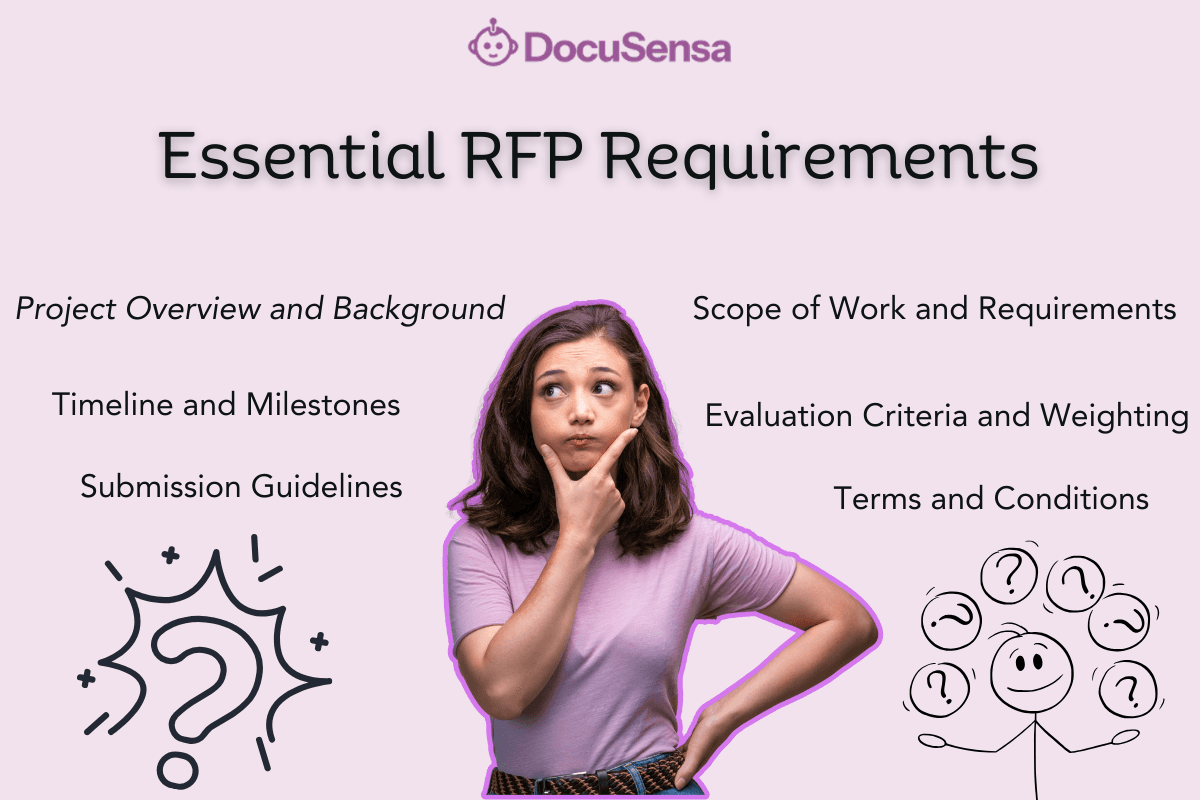
A well-structured RFP includes several critical components that guide vendors toward creating compelling, compliant proposals.
1. Project Overview and Background
This section sets the context by explaining:
Your organization's mission and current situation
The business problem or opportunity driving the RFP
Strategic goals the project should support
Any relevant history or previous attempts to address the challenge
Example: "Our healthcare network operates 12 facilities serving 500,000 patients annually. Our current electronic health record system lacks interoperability across sites, causing clinical inefficiencies and patient safety concerns. We're seeking a modern EHR solution that enables seamless information sharing while meeting HIPAA compliance requirements."
2. Scope of Work and Requirements
This is the heart of your RFP, detailing exactly what you need. Break requirements into clear categories:
Mandatory Requirements (must-haves):
Specific technical capabilities or integrations
Regulatory compliance (GDPR, SOC2, HIPAA)
Performance benchmarks
Security standards
Desired Requirements (nice-to-haves):
Additional features that would add value
Enhanced capabilities beyond baseline needs
Innovative approaches or emerging technologies
Example Requirement: "The solution must integrate with our existing Oracle ERP system via REST API, with data synchronization occurring in real-time (mandatory). The solution should also provide predictive analytics capabilities for inventory forecasting (desired)."
3. Timeline and Milestones
Provide a clear schedule for both the RFP process and the expected project:
RFP Timeline:
RFP release date: January 15, 2025
Written questions deadline: January 29, 2025
Final proposal submission: February 19, 2025, 5:00 PM EST
Vendor presentations: Week of March 4, 2025
Award notification: March 20, 2025
Project Timeline:
Contract signing: April 1, 2025
Project kickoff: April 15, 2025
Phase 1 delivery: June 30, 2025
Final implementation: September 30, 2025
4. Evaluation Criteria and Weighting
Transparency about how you'll score proposals helps vendors focus their efforts appropriately. Assign weights to each evaluation factor:
Criteria | Weight | Description |
Technical Approach | 30% | Solution methodology and innovation |
Experience & Qualifications | 20% | Relevant past work and team credentials |
Implementation Plan | 20% | Timeline, resources, and risk mitigation |
Pricing | 20% | Total cost and value proposition |
References | 10% | Client testimonials and case studies |
This weighting signals that you value technical excellence and implementation strategy over price alone—encouraging vendors to compete on value rather than racing to the bottom on cost.
5. Submission Guidelines
Specify exactly how vendors should structure and submit their proposals:
Format: PDF documents, maximum file size 25MB
Structure: Follow the provided template with specific section ordering
Length: Maximum 50 pages, excluding appendices
Delivery method: Submit via online portal at [portal URL]
Required sections: Executive summary, approach, team bios, pricing table, references
Supporting materials: Case studies, technical documentation, certifications
Clear submission guidelines prevent disqualification due to technical non-compliance and make evaluation more efficient.
6. Terms and Conditions
Include standard legal and business terms:
Confidentiality requirements for proprietary information shared in the RFP
Intellectual property ownership of submitted proposals
Right to reject any or all proposals
Payment terms and conditions
Insurance and bonding requirements
Service level agreements (SLAs)
Termination clauses
RFP Response Best Practices for Vendors
If you're on the receiving end of an RFP, these strategies will strengthen your proposal:
Focus on the Client's Problem, Not Your Product
Lead with the client's challenges and desired outcomes before diving into features. Frame every capability as a benefit that addresses their specific needs.
Weak: "Our CRM includes advanced reporting capabilities with 50+ pre-built dashboards."
Strong: "Your sales leadership will gain real-time visibility into pipeline health through customizable dashboards that highlight at-risk deals and forecast accuracy—enabling proactive coaching and more reliable revenue predictions."
Demonstrate Understanding Through Proof Points
Back every claim with concrete evidence:
Case studies from similar clients in the same industry
Specific metrics showing outcomes achieved
References who can validate your capabilities
Certifications proving compliance expertise
Address Requirements Systematically
Create a compliance matrix that maps each requirement to your response:
RFP Requirement | Section Reference | Compliance Status | Notes |
SOC 2 Type II certification | Appendix C | Fully Compliant | Certificate provided |
99.9% uptime SLA | Section B, Page 8 | Fully Compliant | 99.97% achieved in 2024 |
Mobile apps for iOS/Android | Section B, Page 12 | Fully Compliant | Screenshots provided |
This ensures reviewers can quickly verify compliance without searching through your entire proposal.
Invest in the Executive Summary
Many decision-makers read only the executive summary. Make it count by:
Opening with their most pressing challenge
Summarizing your unique solution approach
Highlighting 3-5 key differentiators
Providing the total investment and expected ROI
Closing with a compelling call-to-action
Keep it to 1-2 pages maximum—concise and compelling.
Common RFP Mistakes to Avoid
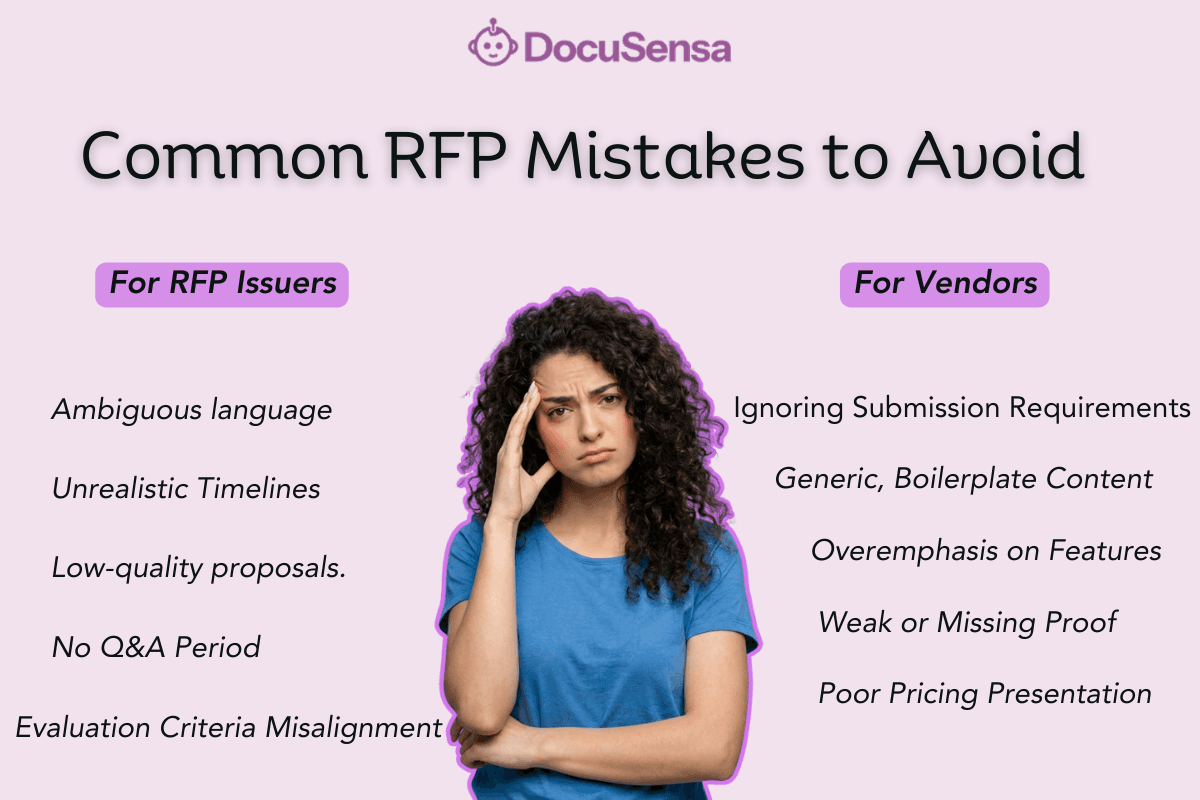
For RFP Issuers:
Vague Requirements: Ambiguous language like "robust security" or "intuitive interface" leads to proposals that miss the mark. Be specific about what you need.
Unrealistic Timelines: Giving vendors only one week to respond to a 50-question RFP results in rushed, low-quality proposals. Allow 3-4 weeks minimum.
Evaluation Criteria Misalignment: If your evaluation heavily weights factors not mentioned in the RFP, vendors can't optimize their responses appropriately.
No Q&A Period: Without opportunity for clarification, you'll receive proposals based on assumptions rather than clear understanding.
For Vendors:
Ignoring Submission Requirements: Getting disqualified for formatting errors or late submission is inexcusable. Follow instructions precisely.
Generic, Boilerplate Content: Copy-pasted proposals that aren't customized to the client's specific situation signal lack of genuine interest.
Overemphasis on Features: Listing every feature without connecting to business value leaves reviewers wondering "So what?"
Weak or Missing Proof: Claims without supporting evidence undermine credibility. Always provide concrete validation.
Poor Pricing Presentation: Confusing cost structures or hidden fees create distrust and make comparison difficult.
How AI Is Transforming the RFP Process
The RFP landscape is undergoing rapid transformation through artificial intelligence, making the process faster and more strategic for both issuers and responders.
For RFP Issuers:
AI-powered platforms can now:
Analyze past RFPs to identify successful language and structures
Suggest requirement categories based on project type
Generate evaluation scorecards automatically
Flag ambiguous or incomplete sections before publication
For RFP Responders:
Modern AI tools revolutionize response efficiency by:
Instantly extracting all requirements from lengthy RFP documents
Identifying mandatory vs. optional requirements
Flagging potential risks in contract terms
Suggesting relevant content from knowledge bases
Generating first-draft responses that teams can refine
DocuSensa, for example, automates the most time-consuming aspects of RFP response. The platform's AI analyzes incoming RFPs in minutes rather than days, extracting key requirements, deadlines, and evaluation criteria into structured, actionable formats. Teams can then focus their energy on strategic differentiation and customization rather than administrative document processing.
For organizations handling multiple RFPs simultaneously, AI automation delivers measurable competitive advantages through faster turnaround, improved consistency, and reduced risk of missing critical requirements.

Streamline Your RFP Process Today
Whether you're issuing RFPs to find the right partners or responding to opportunities in your market, mastering the RFP process drives better business outcomes. Clear requirements, structured evaluation, and strategic responses separate winning organizations from those left behind.
The organizations seeing the highest RFP success rates are those leveraging modern tools to eliminate manual inefficiencies while maintaining quality and compliance.
Ready to transform your RFP workflow? Start your free trial of DocuSensa and experience how AI-powered document intelligence accelerates your proposal process—from requirement extraction to response generation to compliance verification. Join the 500+ teams already saving 20+ hours weekly while increasing their win rates.
Table of Content |
|---|
What Is an RFP (Request for Proposal) |
The Evolution of RFPs |
When Organizations Use RFPs |
Essential RFP Requirements |
RFP Response Best Practices for Vendors |
Common RFP Mistakes to Avoid |
How AI Is Transforming the RFP Process |
Streamline Your RFP Process Today |
What a Request for Proposal Is and Key Requirements
Businesses worldwide issue over $3 trillion in RFPs annually, yet nearly 70% of vendors struggle to respond effectively. Whether you're issuing your first RFP or responding to dozens each year, understanding the fundamentals can mean the difference between securing transformative partnerships and watching opportunities slip away.
This comprehensive guide breaks down everything you need to know about Requests for Proposals—from core requirements to practical examples that bring the concepts to life.
What Is an RFP (Request for Proposal)?
A Request for Proposal (RFP) is a formal business document that organizations use to solicit competitive bids from qualified vendors for complex projects or services. Unlike simple price quotes, an RFP invites vendors to propose creative solutions to business challenges, demonstrate their expertise, and outline how they'll deliver value.
The RFP serves a dual purpose: it helps buyers clearly articulate their needs and evaluation criteria while giving vendors a structured framework to present their capabilities and methodology.
The Evolution of RFPs
Historically, RFPs were dense paper documents distributed via mail, requiring weeks or months to complete the solicitation cycle. Today's RFP process has transformed significantly through digital channels and, most recently, through artificial intelligence. Modern platforms now automate requirement extraction, compliance checking, and even response generation—streamlining what was once a resource-intensive process into something far more efficient.
When Organizations Use RFPs
RFPs are the procurement tool of choice when:
The solution requires customization: The buyer needs vendors to propose how they'll solve a specific problem rather than simply pricing a standard product
Multiple vendors could deliver value: Competition drives better solutions and pricing
Significant investment is involved: Projects typically range from tens of thousands to millions of dollars
Technical complexity exists: The project requires specialized expertise or innovative approaches
Compliance matters: Regulatory requirements, security standards, or organizational policies must be met
Common RFP scenarios include enterprise software implementations, consulting engagements, construction projects, marketing campaigns, and outsourced services.
Essential RFP Requirements
A well-structured RFP includes several critical components that guide vendors toward creating compelling, compliant proposals.
1. Project Overview and Background
This section sets the context by explaining:
Your organization's mission and current situation
The business problem or opportunity driving the RFP
Strategic goals the project should support
Any relevant history or previous attempts to address the challenge
Example: "Our healthcare network operates 12 facilities serving 500,000 patients annually. Our current electronic health record system lacks interoperability across sites, causing clinical inefficiencies and patient safety concerns. We're seeking a modern EHR solution that enables seamless information sharing while meeting HIPAA compliance requirements."
2. Scope of Work and Requirements
This is the heart of your RFP, detailing exactly what you need. Break requirements into clear categories:
Mandatory Requirements (must-haves):
Specific technical capabilities or integrations
Regulatory compliance (GDPR, SOC2, HIPAA)
Performance benchmarks
Security standards
Desired Requirements (nice-to-haves):
Additional features that would add value
Enhanced capabilities beyond baseline needs
Innovative approaches or emerging technologies
Example Requirement: "The solution must integrate with our existing Oracle ERP system via REST API, with data synchronization occurring in real-time (mandatory). The solution should also provide predictive analytics capabilities for inventory forecasting (desired)."
3. Timeline and Milestones
Provide a clear schedule for both the RFP process and the expected project:
RFP Timeline:
RFP release date: January 15, 2025
Written questions deadline: January 29, 2025
Final proposal submission: February 19, 2025, 5:00 PM EST
Vendor presentations: Week of March 4, 2025
Award notification: March 20, 2025
Project Timeline:
Contract signing: April 1, 2025
Project kickoff: April 15, 2025
Phase 1 delivery: June 30, 2025
Final implementation: September 30, 2025
4. Evaluation Criteria and Weighting
Transparency about how you'll score proposals helps vendors focus their efforts appropriately. Assign weights to each evaluation factor:
Criteria | Weight | Description |
Technical Approach | 30% | Solution methodology and innovation |
Experience & Qualifications | 20% | Relevant past work and team credentials |
Implementation Plan | 20% | Timeline, resources, and risk mitigation |
Pricing | 20% | Total cost and value proposition |
References | 10% | Client testimonials and case studies |
This weighting signals that you value technical excellence and implementation strategy over price alone—encouraging vendors to compete on value rather than racing to the bottom on cost.
5. Submission Guidelines
Specify exactly how vendors should structure and submit their proposals:
Format: PDF documents, maximum file size 25MB
Structure: Follow the provided template with specific section ordering
Length: Maximum 50 pages, excluding appendices
Delivery method: Submit via online portal at [portal URL]
Required sections: Executive summary, approach, team bios, pricing table, references
Supporting materials: Case studies, technical documentation, certifications
Clear submission guidelines prevent disqualification due to technical non-compliance and make evaluation more efficient.
6. Terms and Conditions
Include standard legal and business terms:
Confidentiality requirements for proprietary information shared in the RFP
Intellectual property ownership of submitted proposals
Right to reject any or all proposals
Payment terms and conditions
Insurance and bonding requirements
Service level agreements (SLAs)
Termination clauses
RFP Response Best Practices for Vendors
If you're on the receiving end of an RFP, these strategies will strengthen your proposal:
Focus on the Client's Problem, Not Your Product
Lead with the client's challenges and desired outcomes before diving into features. Frame every capability as a benefit that addresses their specific needs.
Weak: "Our CRM includes advanced reporting capabilities with 50+ pre-built dashboards."
Strong: "Your sales leadership will gain real-time visibility into pipeline health through customizable dashboards that highlight at-risk deals and forecast accuracy—enabling proactive coaching and more reliable revenue predictions."
Demonstrate Understanding Through Proof Points
Back every claim with concrete evidence:
Case studies from similar clients in the same industry
Specific metrics showing outcomes achieved
References who can validate your capabilities
Certifications proving compliance expertise
Address Requirements Systematically
Create a compliance matrix that maps each requirement to your response:
RFP Requirement | Section Reference | Compliance Status | Notes |
SOC 2 Type II certification | Appendix C | Fully Compliant | Certificate provided |
99.9% uptime SLA | Section B, Page 8 | Fully Compliant | 99.97% achieved in 2024 |
Mobile apps for iOS/Android | Section B, Page 12 | Fully Compliant | Screenshots provided |
This ensures reviewers can quickly verify compliance without searching through your entire proposal.
Invest in the Executive Summary
Many decision-makers read only the executive summary. Make it count by:
Opening with their most pressing challenge
Summarizing your unique solution approach
Highlighting 3-5 key differentiators
Providing the total investment and expected ROI
Closing with a compelling call-to-action
Keep it to 1-2 pages maximum—concise and compelling.
Common RFP Mistakes to Avoid
For RFP Issuers:
Vague Requirements: Ambiguous language like "robust security" or "intuitive interface" leads to proposals that miss the mark. Be specific about what you need.
Unrealistic Timelines: Giving vendors only one week to respond to a 50-question RFP results in rushed, low-quality proposals. Allow 3-4 weeks minimum.
Evaluation Criteria Misalignment: If your evaluation heavily weights factors not mentioned in the RFP, vendors can't optimize their responses appropriately.
No Q&A Period: Without opportunity for clarification, you'll receive proposals based on assumptions rather than clear understanding.
For Vendors:
Ignoring Submission Requirements: Getting disqualified for formatting errors or late submission is inexcusable. Follow instructions precisely.
Generic, Boilerplate Content: Copy-pasted proposals that aren't customized to the client's specific situation signal lack of genuine interest.
Overemphasis on Features: Listing every feature without connecting to business value leaves reviewers wondering "So what?"
Weak or Missing Proof: Claims without supporting evidence undermine credibility. Always provide concrete validation.
Poor Pricing Presentation: Confusing cost structures or hidden fees create distrust and make comparison difficult.
How AI Is Transforming the RFP Process
The RFP landscape is undergoing rapid transformation through artificial intelligence, making the process faster and more strategic for both issuers and responders.
For RFP Issuers:
AI-powered platforms can now:
Analyze past RFPs to identify successful language and structures
Suggest requirement categories based on project type
Generate evaluation scorecards automatically
Flag ambiguous or incomplete sections before publication
For RFP Responders:
Modern AI tools revolutionize response efficiency by:
Instantly extracting all requirements from lengthy RFP documents
Identifying mandatory vs. optional requirements
Flagging potential risks in contract terms
Suggesting relevant content from knowledge bases
Generating first-draft responses that teams can refine
DocuSensa, for example, automates the most time-consuming aspects of RFP response. The platform's AI analyzes incoming RFPs in minutes rather than days, extracting key requirements, deadlines, and evaluation criteria into structured, actionable formats. Teams can then focus their energy on strategic differentiation and customization rather than administrative document processing.
For organizations handling multiple RFPs simultaneously, AI automation delivers measurable competitive advantages through faster turnaround, improved consistency, and reduced risk of missing critical requirements.
Streamline Your RFP Process Today
Whether you're issuing RFPs to find the right partners or responding to opportunities in your market, mastering the RFP process drives better business outcomes. Clear requirements, structured evaluation, and strategic responses separate winning organizations from those left behind.
The organizations seeing the highest RFP success rates are those leveraging modern tools to eliminate manual inefficiencies while maintaining quality and compliance.
Ready to transform your RFP workflow? Start your free trial of DocuSensa and experience how AI-powered document intelligence accelerates your proposal process—from requirement extraction to response generation to compliance verification. Join the 500+ teams already saving 20+ hours weekly while increasing their win rates.
Table of Content |
|---|
What Is an RFP (Request for Proposal) |
The Evolution of RFPs |
When Organizations Use RFPs |
Essential RFP Requirements |
RFP Response Best Practices for Vendors |
Common RFP Mistakes to Avoid |
How AI Is Transforming the RFP Process |
Streamline Your RFP Process Today |
What a Request for Proposal Is and Key Requirements
Businesses worldwide issue over $3 trillion in RFPs annually, yet nearly 70% of vendors struggle to respond effectively. Whether you're issuing your first RFP or responding to dozens each year, understanding the fundamentals can mean the difference between securing transformative partnerships and watching opportunities slip away.
This comprehensive guide breaks down everything you need to know about Requests for Proposals—from core requirements to practical examples that bring the concepts to life.
What Is an RFP (Request for Proposal)?
A Request for Proposal (RFP) is a formal business document that organizations use to solicit competitive bids from qualified vendors for complex projects or services. Unlike simple price quotes, an RFP invites vendors to propose creative solutions to business challenges, demonstrate their expertise, and outline how they'll deliver value.
The RFP serves a dual purpose: it helps buyers clearly articulate their needs and evaluation criteria while giving vendors a structured framework to present their capabilities and methodology.
The Evolution of RFPs
Historically, RFPs were dense paper documents distributed via mail, requiring weeks or months to complete the solicitation cycle. Today's RFP process has transformed significantly through digital channels and, most recently, through artificial intelligence. Modern platforms now automate requirement extraction, compliance checking, and even response generation—streamlining what was once a resource-intensive process into something far more efficient.
When Organizations Use RFPs
RFPs are the procurement tool of choice when:
The solution requires customization: The buyer needs vendors to propose how they'll solve a specific problem rather than simply pricing a standard product
Multiple vendors could deliver value: Competition drives better solutions and pricing
Significant investment is involved: Projects typically range from tens of thousands to millions of dollars
Technical complexity exists: The project requires specialized expertise or innovative approaches
Compliance matters: Regulatory requirements, security standards, or organizational policies must be met
Common RFP scenarios include enterprise software implementations, consulting engagements, construction projects, marketing campaigns, and outsourced services.
Essential RFP Requirements
A well-structured RFP includes several critical components that guide vendors toward creating compelling, compliant proposals.
1. Project Overview and Background
This section sets the context by explaining:
Your organization's mission and current situation
The business problem or opportunity driving the RFP
Strategic goals the project should support
Any relevant history or previous attempts to address the challenge
Example: "Our healthcare network operates 12 facilities serving 500,000 patients annually. Our current electronic health record system lacks interoperability across sites, causing clinical inefficiencies and patient safety concerns. We're seeking a modern EHR solution that enables seamless information sharing while meeting HIPAA compliance requirements."
2. Scope of Work and Requirements
This is the heart of your RFP, detailing exactly what you need. Break requirements into clear categories:
Mandatory Requirements (must-haves):
Specific technical capabilities or integrations
Regulatory compliance (GDPR, SOC2, HIPAA)
Performance benchmarks
Security standards
Desired Requirements (nice-to-haves):
Additional features that would add value
Enhanced capabilities beyond baseline needs
Innovative approaches or emerging technologies
Example Requirement: "The solution must integrate with our existing Oracle ERP system via REST API, with data synchronization occurring in real-time (mandatory). The solution should also provide predictive analytics capabilities for inventory forecasting (desired)."
3. Timeline and Milestones
Provide a clear schedule for both the RFP process and the expected project:
RFP Timeline:
RFP release date: January 15, 2025
Written questions deadline: January 29, 2025
Final proposal submission: February 19, 2025, 5:00 PM EST
Vendor presentations: Week of March 4, 2025
Award notification: March 20, 2025
Project Timeline:
Contract signing: April 1, 2025
Project kickoff: April 15, 2025
Phase 1 delivery: June 30, 2025
Final implementation: September 30, 2025
4. Evaluation Criteria and Weighting
Transparency about how you'll score proposals helps vendors focus their efforts appropriately. Assign weights to each evaluation factor:
Criteria | Weight | Description |
Technical Approach | 30% | Solution methodology and innovation |
Experience & Qualifications | 20% | Relevant past work and team credentials |
Implementation Plan | 20% | Timeline, resources, and risk mitigation |
Pricing | 20% | Total cost and value proposition |
References | 10% | Client testimonials and case studies |
This weighting signals that you value technical excellence and implementation strategy over price alone—encouraging vendors to compete on value rather than racing to the bottom on cost.
5. Submission Guidelines
Specify exactly how vendors should structure and submit their proposals:
Format: PDF documents, maximum file size 25MB
Structure: Follow the provided template with specific section ordering
Length: Maximum 50 pages, excluding appendices
Delivery method: Submit via online portal at [portal URL]
Required sections: Executive summary, approach, team bios, pricing table, references
Supporting materials: Case studies, technical documentation, certifications
Clear submission guidelines prevent disqualification due to technical non-compliance and make evaluation more efficient.
6. Terms and Conditions
Include standard legal and business terms:
Confidentiality requirements for proprietary information shared in the RFP
Intellectual property ownership of submitted proposals
Right to reject any or all proposals
Payment terms and conditions
Insurance and bonding requirements
Service level agreements (SLAs)
Termination clauses
RFP Response Best Practices for Vendors
If you're on the receiving end of an RFP, these strategies will strengthen your proposal:
Focus on the Client's Problem, Not Your Product
Lead with the client's challenges and desired outcomes before diving into features. Frame every capability as a benefit that addresses their specific needs.
Weak: "Our CRM includes advanced reporting capabilities with 50+ pre-built dashboards."
Strong: "Your sales leadership will gain real-time visibility into pipeline health through customizable dashboards that highlight at-risk deals and forecast accuracy—enabling proactive coaching and more reliable revenue predictions."
Demonstrate Understanding Through Proof Points
Back every claim with concrete evidence:
Case studies from similar clients in the same industry
Specific metrics showing outcomes achieved
References who can validate your capabilities
Certifications proving compliance expertise
Address Requirements Systematically
Create a compliance matrix that maps each requirement to your response:
RFP Requirement | Section Reference | Compliance Status | Notes |
SOC 2 Type II certification | Appendix C | Fully Compliant | Certificate provided |
99.9% uptime SLA | Section B, Page 8 | Fully Compliant | 99.97% achieved in 2024 |
Mobile apps for iOS/Android | Section B, Page 12 | Fully Compliant | Screenshots provided |
This ensures reviewers can quickly verify compliance without searching through your entire proposal.
Invest in the Executive Summary
Many decision-makers read only the executive summary. Make it count by:
Opening with their most pressing challenge
Summarizing your unique solution approach
Highlighting 3-5 key differentiators
Providing the total investment and expected ROI
Closing with a compelling call-to-action
Keep it to 1-2 pages maximum—concise and compelling.
Common RFP Mistakes to Avoid
For RFP Issuers:
Vague Requirements: Ambiguous language like "robust security" or "intuitive interface" leads to proposals that miss the mark. Be specific about what you need.
Unrealistic Timelines: Giving vendors only one week to respond to a 50-question RFP results in rushed, low-quality proposals. Allow 3-4 weeks minimum.
Evaluation Criteria Misalignment: If your evaluation heavily weights factors not mentioned in the RFP, vendors can't optimize their responses appropriately.
No Q&A Period: Without opportunity for clarification, you'll receive proposals based on assumptions rather than clear understanding.
For Vendors:
Ignoring Submission Requirements: Getting disqualified for formatting errors or late submission is inexcusable. Follow instructions precisely.
Generic, Boilerplate Content: Copy-pasted proposals that aren't customized to the client's specific situation signal lack of genuine interest.
Overemphasis on Features: Listing every feature without connecting to business value leaves reviewers wondering "So what?"
Weak or Missing Proof: Claims without supporting evidence undermine credibility. Always provide concrete validation.
Poor Pricing Presentation: Confusing cost structures or hidden fees create distrust and make comparison difficult.
How AI Is Transforming the RFP Process
The RFP landscape is undergoing rapid transformation through artificial intelligence, making the process faster and more strategic for both issuers and responders.
For RFP Issuers:
AI-powered platforms can now:
Analyze past RFPs to identify successful language and structures
Suggest requirement categories based on project type
Generate evaluation scorecards automatically
Flag ambiguous or incomplete sections before publication
For RFP Responders:
Modern AI tools revolutionize response efficiency by:
Instantly extracting all requirements from lengthy RFP documents
Identifying mandatory vs. optional requirements
Flagging potential risks in contract terms
Suggesting relevant content from knowledge bases
Generating first-draft responses that teams can refine
DocuSensa, for example, automates the most time-consuming aspects of RFP response. The platform's AI analyzes incoming RFPs in minutes rather than days, extracting key requirements, deadlines, and evaluation criteria into structured, actionable formats. Teams can then focus their energy on strategic differentiation and customization rather than administrative document processing.
For organizations handling multiple RFPs simultaneously, AI automation delivers measurable competitive advantages through faster turnaround, improved consistency, and reduced risk of missing critical requirements.
Streamline Your RFP Process Today
Whether you're issuing RFPs to find the right partners or responding to opportunities in your market, mastering the RFP process drives better business outcomes. Clear requirements, structured evaluation, and strategic responses separate winning organizations from those left behind.
The organizations seeing the highest RFP success rates are those leveraging modern tools to eliminate manual inefficiencies while maintaining quality and compliance.
Ready to transform your RFP workflow? Start your free trial of DocuSensa and experience how AI-powered document intelligence accelerates your proposal process—from requirement extraction to response generation to compliance verification. Join the 500+ teams already saving 20+ hours weekly while increasing their win rates.
Table of Content |
|---|
What Is an RFP (Request for Proposal) |
The Evolution of RFPs |
When Organizations Use RFPs |
Essential RFP Requirements |
RFP Response Best Practices for Vendors |
Common RFP Mistakes to Avoid |
How AI Is Transforming the RFP Process |
Streamline Your RFP Process Today |
What a Request for Proposal Is and Key Requirements
Businesses worldwide issue over $3 trillion in RFPs annually, yet nearly 70% of vendors struggle to respond effectively. Whether you're issuing your first RFP or responding to dozens each year, understanding the fundamentals can mean the difference between securing transformative partnerships and watching opportunities slip away.
This comprehensive guide breaks down everything you need to know about Requests for Proposals—from core requirements to practical examples that bring the concepts to life.
What Is an RFP (Request for Proposal)?
A Request for Proposal (RFP) is a formal business document that organizations use to solicit competitive bids from qualified vendors for complex projects or services. Unlike simple price quotes, an RFP invites vendors to propose creative solutions to business challenges, demonstrate their expertise, and outline how they'll deliver value.
The RFP serves a dual purpose: it helps buyers clearly articulate their needs and evaluation criteria while giving vendors a structured framework to present their capabilities and methodology.
The Evolution of RFPs
Historically, RFPs were dense paper documents distributed via mail, requiring weeks or months to complete the solicitation cycle. Today's RFP process has transformed significantly through digital channels and, most recently, through artificial intelligence. Modern platforms now automate requirement extraction, compliance checking, and even response generation—streamlining what was once a resource-intensive process into something far more efficient.
When Organizations Use RFPs
RFPs are the procurement tool of choice when:
The solution requires customization: The buyer needs vendors to propose how they'll solve a specific problem rather than simply pricing a standard product
Multiple vendors could deliver value: Competition drives better solutions and pricing
Significant investment is involved: Projects typically range from tens of thousands to millions of dollars
Technical complexity exists: The project requires specialized expertise or innovative approaches
Compliance matters: Regulatory requirements, security standards, or organizational policies must be met
Common RFP scenarios include enterprise software implementations, consulting engagements, construction projects, marketing campaigns, and outsourced services.
Essential RFP Requirements
A well-structured RFP includes several critical components that guide vendors toward creating compelling, compliant proposals.
1. Project Overview and Background
This section sets the context by explaining:
Your organization's mission and current situation
The business problem or opportunity driving the RFP
Strategic goals the project should support
Any relevant history or previous attempts to address the challenge
Example: "Our healthcare network operates 12 facilities serving 500,000 patients annually. Our current electronic health record system lacks interoperability across sites, causing clinical inefficiencies and patient safety concerns. We're seeking a modern EHR solution that enables seamless information sharing while meeting HIPAA compliance requirements."
2. Scope of Work and Requirements
This is the heart of your RFP, detailing exactly what you need. Break requirements into clear categories:
Mandatory Requirements (must-haves):
Specific technical capabilities or integrations
Regulatory compliance (GDPR, SOC2, HIPAA)
Performance benchmarks
Security standards
Desired Requirements (nice-to-haves):
Additional features that would add value
Enhanced capabilities beyond baseline needs
Innovative approaches or emerging technologies
Example Requirement: "The solution must integrate with our existing Oracle ERP system via REST API, with data synchronization occurring in real-time (mandatory). The solution should also provide predictive analytics capabilities for inventory forecasting (desired)."
3. Timeline and Milestones
Provide a clear schedule for both the RFP process and the expected project:
RFP Timeline:
RFP release date: January 15, 2025
Written questions deadline: January 29, 2025
Final proposal submission: February 19, 2025, 5:00 PM EST
Vendor presentations: Week of March 4, 2025
Award notification: March 20, 2025
Project Timeline:
Contract signing: April 1, 2025
Project kickoff: April 15, 2025
Phase 1 delivery: June 30, 2025
Final implementation: September 30, 2025
4. Evaluation Criteria and Weighting
Transparency about how you'll score proposals helps vendors focus their efforts appropriately. Assign weights to each evaluation factor:
Criteria | Weight | Description |
Technical Approach | 30% | Solution methodology and innovation |
Experience & Qualifications | 20% | Relevant past work and team credentials |
Implementation Plan | 20% | Timeline, resources, and risk mitigation |
Pricing | 20% | Total cost and value proposition |
References | 10% | Client testimonials and case studies |
This weighting signals that you value technical excellence and implementation strategy over price alone—encouraging vendors to compete on value rather than racing to the bottom on cost.
5. Submission Guidelines
Specify exactly how vendors should structure and submit their proposals:
Format: PDF documents, maximum file size 25MB
Structure: Follow the provided template with specific section ordering
Length: Maximum 50 pages, excluding appendices
Delivery method: Submit via online portal at [portal URL]
Required sections: Executive summary, approach, team bios, pricing table, references
Supporting materials: Case studies, technical documentation, certifications
Clear submission guidelines prevent disqualification due to technical non-compliance and make evaluation more efficient.
6. Terms and Conditions
Include standard legal and business terms:
Confidentiality requirements for proprietary information shared in the RFP
Intellectual property ownership of submitted proposals
Right to reject any or all proposals
Payment terms and conditions
Insurance and bonding requirements
Service level agreements (SLAs)
Termination clauses
RFP Response Best Practices for Vendors
If you're on the receiving end of an RFP, these strategies will strengthen your proposal:
Focus on the Client's Problem, Not Your Product
Lead with the client's challenges and desired outcomes before diving into features. Frame every capability as a benefit that addresses their specific needs.
Weak: "Our CRM includes advanced reporting capabilities with 50+ pre-built dashboards."
Strong: "Your sales leadership will gain real-time visibility into pipeline health through customizable dashboards that highlight at-risk deals and forecast accuracy—enabling proactive coaching and more reliable revenue predictions."
Demonstrate Understanding Through Proof Points
Back every claim with concrete evidence:
Case studies from similar clients in the same industry
Specific metrics showing outcomes achieved
References who can validate your capabilities
Certifications proving compliance expertise
Address Requirements Systematically
Create a compliance matrix that maps each requirement to your response:
RFP Requirement | Section Reference | Compliance Status | Notes |
SOC 2 Type II certification | Appendix C | Fully Compliant | Certificate provided |
99.9% uptime SLA | Section B, Page 8 | Fully Compliant | 99.97% achieved in 2024 |
Mobile apps for iOS/Android | Section B, Page 12 | Fully Compliant | Screenshots provided |
This ensures reviewers can quickly verify compliance without searching through your entire proposal.
Invest in the Executive Summary
Many decision-makers read only the executive summary. Make it count by:
Opening with their most pressing challenge
Summarizing your unique solution approach
Highlighting 3-5 key differentiators
Providing the total investment and expected ROI
Closing with a compelling call-to-action
Keep it to 1-2 pages maximum—concise and compelling.
Common RFP Mistakes to Avoid
For RFP Issuers:
Vague Requirements: Ambiguous language like "robust security" or "intuitive interface" leads to proposals that miss the mark. Be specific about what you need.
Unrealistic Timelines: Giving vendors only one week to respond to a 50-question RFP results in rushed, low-quality proposals. Allow 3-4 weeks minimum.
Evaluation Criteria Misalignment: If your evaluation heavily weights factors not mentioned in the RFP, vendors can't optimize their responses appropriately.
No Q&A Period: Without opportunity for clarification, you'll receive proposals based on assumptions rather than clear understanding.
For Vendors:
Ignoring Submission Requirements: Getting disqualified for formatting errors or late submission is inexcusable. Follow instructions precisely.
Generic, Boilerplate Content: Copy-pasted proposals that aren't customized to the client's specific situation signal lack of genuine interest.
Overemphasis on Features: Listing every feature without connecting to business value leaves reviewers wondering "So what?"
Weak or Missing Proof: Claims without supporting evidence undermine credibility. Always provide concrete validation.
Poor Pricing Presentation: Confusing cost structures or hidden fees create distrust and make comparison difficult.
How AI Is Transforming the RFP Process
The RFP landscape is undergoing rapid transformation through artificial intelligence, making the process faster and more strategic for both issuers and responders.
For RFP Issuers:
AI-powered platforms can now:
Analyze past RFPs to identify successful language and structures
Suggest requirement categories based on project type
Generate evaluation scorecards automatically
Flag ambiguous or incomplete sections before publication
For RFP Responders:
Modern AI tools revolutionize response efficiency by:
Instantly extracting all requirements from lengthy RFP documents
Identifying mandatory vs. optional requirements
Flagging potential risks in contract terms
Suggesting relevant content from knowledge bases
Generating first-draft responses that teams can refine
DocuSensa, for example, automates the most time-consuming aspects of RFP response. The platform's AI analyzes incoming RFPs in minutes rather than days, extracting key requirements, deadlines, and evaluation criteria into structured, actionable formats. Teams can then focus their energy on strategic differentiation and customization rather than administrative document processing.
For organizations handling multiple RFPs simultaneously, AI automation delivers measurable competitive advantages through faster turnaround, improved consistency, and reduced risk of missing critical requirements.
Streamline Your RFP Process Today
Whether you're issuing RFPs to find the right partners or responding to opportunities in your market, mastering the RFP process drives better business outcomes. Clear requirements, structured evaluation, and strategic responses separate winning organizations from those left behind.
The organizations seeing the highest RFP success rates are those leveraging modern tools to eliminate manual inefficiencies while maintaining quality and compliance.
Ready to transform your RFP workflow? Start your free trial of DocuSensa and experience how AI-powered document intelligence accelerates your proposal process—from requirement extraction to response generation to compliance verification. Join the 500+ teams already saving 20+ hours weekly while increasing their win rates.
Want more insights like this?
Want more insights like this?
Want more insights like this?
DocuSensa helps teams write faster, smarter Proposals with AI
DocuSensa helps teams write faster, smarter Proposals with AI
DocuSensa helps teams write faster, smarter Proposals with AI
Schedule a Call
Schedule a Call
Schedule a Call